
Enterprise Architecture Framework Comparison: Which Is Right for You?
Why Use an Optimized Enterprise Architecture Framework?
What to Look for in an Enterprise Architecture Framework?
Expected Parts of an Enterprise Architecture Framework
Selecting the Right Off-the-Shelf Frameworks
Enterprise Architecture Framework Selection Infographic
Selecting the Right Enterprise Architecture Framework
Enterprise Architecture Framework Comparison
How to Create an Optimized Enterprise Architecture Framework

Why use an Optimized Enterprise Architecture Framework?
The reason to use an optimized enterprise architecture framework is simple - enterprise architect's are paid to guide effective change, not invent how to do their job.
Optimized enterprise architecture framework will improve productivity and quality
First, a framework will speed up your work
Second, using a framework improves the quality of your work work
There are many different enterprise architecture frameworks. Each is built with different principles. Four of the most commonly used frameworks are TOGAF, Zachman, FEAF, and DoDAF.
We’ve created an enterprise architecture framework comparison to look at the merits of each.
Why start with an Off-the-Shelf Enterprise Architecture Framework?
The reason to start with an off-the-shelf enterprise architecture framework is simple - enterprise architect's are paid to guide effective change, not invent how to do their job.
enterprise architect's are paid to guide effective change, not invent how to do their job
No off-the-shelf framework will be optimized for you. Your enterprise and use case require tweaks. However, you should always start with a standard framework to minimize the burden. Many standard frameworks exist.
With so many different architecture frameworks to choose from, which is the right one for you?
What to look for in an Enterprise Architecture Framework?
With so many different architecture frameworks to choose from, which is the right one for you?
We take a look at your options with this enterprise architecture framework comparison.
When considering a framework look for the scaffolding that:
- exposes all the work your EA Team needs to perform
- provides supporting tools to do the work
- directly enables your enterprise architecture use case
No off-the-shelf framework will be optimized for you. Your enterprise and use case require tweaks. However, you should always start with a standard framework to minimize the burden. Many standard frameworks exist. We classify them as comprehensive, industry, or domain frameworks.

Agentic AI Playbook Conversations
Agentic AI Playbook Conversations We have been been deeply immersed in the evolving landscape of AI Adoption, engaging in a journey encompassing both technical intricacies and broader digital transformation. We developed the Business Leader’s Guide […]

Download AI Adoption Critical Capability Reference Architecture
Download AI Adoption Critical Capability Reference Architecture AI Adoption requires innovation thinking. Today we do not have proven best-practices for widespread AI Adoption that consistently improve our organizations. We require the ability to re-imagine our […]
Download Business Leader’s Guide to AI
Download Business Leader’s Guide to Artificial Intelligence Organizations that successfully apply innovative technology have had a competitive advantage. Innovative technology does not come with established success patterns and best practices. Innovative technology is novel and […]

Download the Introduction to the TOGAF Standard, 10th Edition
Download Introduction to the TOGAF® Standard, 10th Edition The TOGAF Standard, 10th Edition makes adoption of enterprise architecture best practices easier. It separates the universal concepts from proven best practice. The standard underscore where to […]

Download Capability-based Planning Guide
Download Capability-based Planning Guide Always drive to realize value. Half an improvement is 100% waste! No one teaches an Eagle to crawl, walk, or run. Eagles Fly! Download Teach your Eagles to Fly: Capability-based Planning […]

Download Business Architecture Capability Assessment Guide
Download Business Architecture Capability Assessment Guide Download a Business Architecture Capability Assessment Guide. Capability-based planning is one of the most powerful business architecture improvement techniques. Best practice of capability-based planning uses capability as a management […]

Download Sample Enterprise Architecture Principles
Download Sample Architecture Principles Download a sample enterprise architecture principles. Enterprise Architecture principles identify how to approach a problem or decision. The approach always drives you towards your enduring priorities. Download Sample Enterprise Architecture Principles […]

Download Enterprise Architecture Governance Guide
Download Enterprise Architecture Governance Guide Download the Enterprise Architecture Governance Guide to understand best practice to direct and control the development of architecture, and change to obtain the expected outcomes. Download Enterprise Architecture Governance Guide […]

Download TOGAF and SABSA Integration
Download TOGAF and SABSA Integration Bring SABSA, the world’s best security architecture framework, and TOGAF, the industry standard enterprise architecture framework together. Download TOGAF and SABSA Integration TOGAF and SABSA Integration Includes SABSA uses a […]

Download Enterprise Architecture Capability Reference Architecture
Download Enterprise Architecture Capability Reference Architecture The Enterprise Architecture Capability Reference Architecture will speed up establishing and enhancing your EA Team. Design your Enterprise Architecture Team for success. Identify and enhance the your enterprise architecture […]
Expected Parts of an Enterprise Architecture Framework
We expect to see tools and method optimized for the use case.
- Tools
- Analytic Models
- Viewpoint Library
- Reference Architecture
- Architecture Specifications
- Deliverables
- Method
- Architecture Development Method
- Transition to Implementation
- Implementation Governance
- Enterprise Architecture Work Management
Enterprise Architecture Framework Elements Applicability to EA Use Cases
Enterprise Architecture Use Case |
||||
Strategy |
Portfolio |
Project |
Solution Delivery |
|
Tools |
||||
| Analytic Models | Required | Critical | Helpful | Optional |
| Viewpoint Library | Required | Required | Helpful | Helpful |
| Reference Architecture | Optional | Required | Required | Critical |
| Architecture Specifications | Optional | Optional | Optional | Optional |
| Deliverables | Helpful | Helpful | Helpful | Helpful |
Method |
||||
| Architecture Development Method | Helpful | Helpful | Helpful | Helpful |
| Transition to Implementation | Optional | Required | Required | Optional |
| Implementation Governance | Helpful | Required | Required | Required |
| Enterprise Architecture Work Management | Helpful | Helpful | Helpful | Helpful |

Selecting the Right Enterprise Architecture Framework
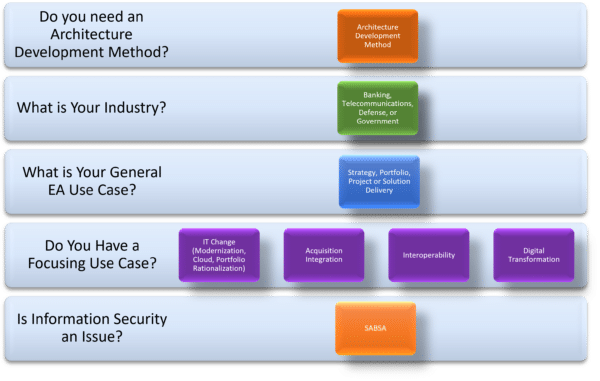
It is unlikely you will start with a single enterprise architecture framework. To select the the right enterprise architecture frameworks to start with answer the questions in the infographic to the right.
We'll use a metaphor of a shopping basket.
Do you need an Architecture Development Method?
Yes, add the TOGAF Framework to your starting set of frameworks.
No, move to the next question with an empty basket.
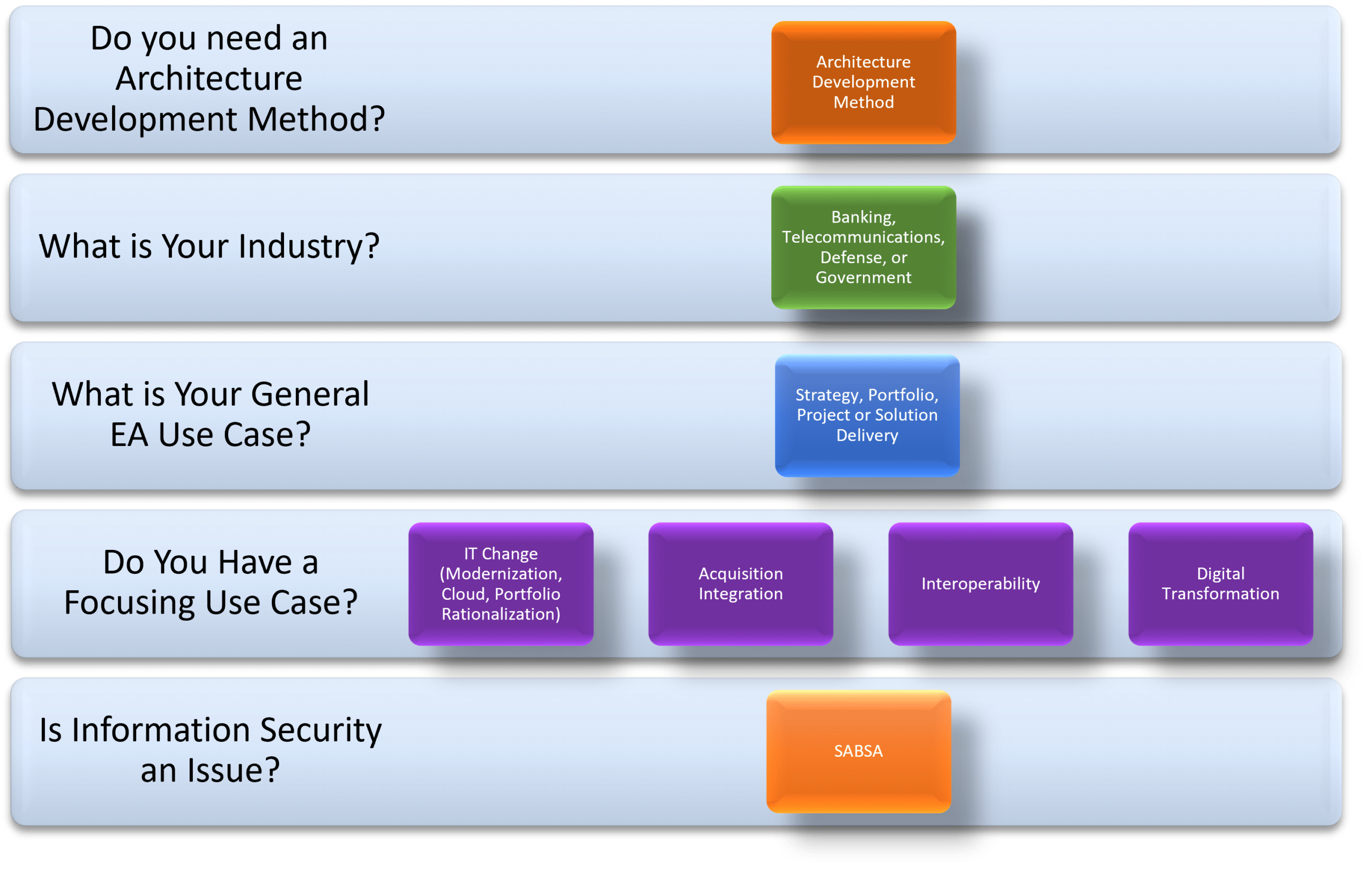
What is your Industry?
There are specific enterprise architecture frameworks for:
Banking, add BIAN to your basket.
The BIAN Reference Architectures will take a central role in your optimized enterprise architecture framework.
Telecommunications, add eTOM to your basket.
The eTOM Reference Architectures will take a central role in your optimized enterprise architecture framework.
Defence, if you are architecting defense operations or a defence solution add DODAF.
However, if you are working on the enterprise architecture of a defence contractor do not put TOGAF in your basket. Your product division will use DODAF for the products.
Note: You may look to one of the DODAF Family, DNDAF in Canada, MPDAF in the UK, etc. All are derivatives of DODAF and focused on long-lived systems integration.
Government, add FEAF or IndEA you your basket. Also get a copy of the guide to establishing an EA capability in the government.
The FEAF and IndEA government reference architectures will likely take a central role in your optimized enterprise architecture framework. However the use case questions may cause you to put these back on the shelf. FEAF and IndEA are optimized for the portfolio use case and are very IT-centric.
What is your General EA Use Case?
There are specific enterprise architecture frameworks for:
Strategy,
Portfolio,
Project,
Solution Delivery,
Do You Have a Focusing Enterprise Architecture Use Case?
IT Change (Modernization, Cloud, Portfolio Rationalization),
Acquisition Integration,
Interoperability,
Digital Transformation,
Is Information Security an Issue?
Yes, add the SABSA Framework to your starting set of frameworks.
With the contents of your basket you might waht to jump down to How to Create an Optimized Enterprise Architecture Framework
Enterprise Architecture Capability Reference Architecture
Download the Enterprise Architecture Capability Reference Architecture. It is the foundation of building a solid enterprise architecture team.
Your Enterprise Architecture Capability model is central to an optimized enterprise architecture capability framework.
Enterprise Architecture Framework Comparison
The Open Group Architectural Framework (TOGAF)
TOGAF is the most widely used enterprise architecture framework and accounts for over 80 percent of framework selections. Although TOGAF is common, it is often implemented very lightly.
TOGAF is a comprehensive framework.
TOGAF Framework |
||
| Tools | ||
| Analytic Models | Limited
|
|
| Practitioner's Guide | ||
| Architecture Specifications | Limited | |
| Deliverables | Topical list | |
| Method | ||
| Architecture Development Method | Comprehensive Architecture Development Method is generic method covering many enterprise architecture use cases.
Specific how-to methods include:
|
|
| Transition to Implementation | Phase E (Opportunities & Solutions) and Phase F (Implementation Planning) in Comprehensive Architecture Development Method | |
| Implementation Governance | Phase G (Implementation Governance) in Comprehensive Architecture Development Method | |
| Enterprise Architecture Work Management | Missing | |
The Zachman Framework
The Zachman Framework is a schema that focuses on six questions (why, how, what, who, where, and when) and five perspectives: (planner, owner, designer, implementer, and subcontractor). The ways these focuses interconnect and come together give a powerful insight into how a business operates.
By understanding how each point connects to the others, you create a powerful framework that allows you to streamline and optimize your operations.
However, as an EA Framework Zachman is quite limited.
Zachman Framework |
||
| Tools | ||
| Analytic Models | Missing | |
| Viewpoint Library | This is the core of the Zachman Framework | |
| Reference Architecture | Missing | |
| Architecture Specifications | Missing | |
| Deliverables | Missing | |
| Method | ||
| Architecture Development Method | Missing | |
| Transition to Implementation | Missing | |
| Implementation Governance | Missing | |
| Enterprise Architecture Work Management | Missing | |


Federal Enterprise Architectural Framework (FEAF)
FEAF, an enterprise architecture framework created by the US Federal Government. it is designed around portfolio planning.
It aims to provide five reference models.
These five reference models: performance, business, data, application, and infrastructure drive a portfolio analysis.
FEAF is an industry framework.
FEAF Framework |
||
| Tools | ||
| Analytic Models | Missing | |
| Viewpoint Library | Missing | |
| Reference Architecture | Core of FEAF
|
|
| Architecture Specifications | Limited use of concept | |
| Deliverables | Limited to completing the reference material | |
| Method | ||
| Architecture Development Method | Limited to completing the reference material. Silent on analysis or use. | |
| Transition to Implementation | Limited. While the reference models are deeply aligned to portfolio analysis how to perform the portfolio analysis is not included. | |
| Implementation Governance | Missing | |
| Enterprise Architecture Work Management | Missing | |
BIAN
BIAN, an enterprise architecture framework developed by Banking Industry Architecture Network. it is designed around portfolio planning.
BIAN is an industry framework.
BIAN Framework |
||
| Tools | ||
| Analytic Models | Missing | |
| Viewpoint Library | Missing | |
| Reference Architecture | Core of FEAF
|
|
| Architecture Specifications | Limited use of concept | |
| Deliverables | Limited to completing the reference material | |
| Method | ||
| Architecture Development Method | Limited to completing the reference material. Silent on analysis or use. | |
| Transition to Implementation | Limited. While the reference models are deeply aligned to portfolio analysis how to perform the portfolio analysis is not included. | |
| Implementation Governance | Missing | |
| Enterprise Architecture Work Management | Missing | |
Department of Defense Architecture Framework (DoDAF)
The DoDAF enterprise architecture framework was developed by the US Department of Defense to address interoperability. It provides tabular, structural and graphical means.
DODAF's architecture views form the core, and are focused on how a complex system works together. The DoDaF framework starts with clearly defined operational views, then creates specific work products products that describe how a complex system of systems fits together.
DODAF is an industry framework.
DODAF Framework |
||
| Tools | ||
| Analytic Models | Missing | |
| Viewpoint Library | Comprehensive
End-to-end viewpoint library that highlights the purpose of a complex system, parts of the system, and how the system interoperates. It is very well suited to interoperability of long-lives components. |
|
| Reference Architecture | Missing | |
| Architecture Specifications | Limited Several of the Viewpoint focus on interoperability standards and specifications |
|
| Deliverables | Limited | |
| Method | ||
| Architecture Development Method | Limited to completing the reference material. Silent on analysis or use. | |
| Transition to Implementation | Missing | |
| Implementation Governance | Missing | |
| Enterprise Architecture Work Management | Missing | |
Go Further with Best Practice Enterprise Architecture Process and Method
Best practice enterprise architecture from Conexiam Navigate

Understanding Enterprise Architecture and Agile
Understanding Enterprise Architecture and Agile Both agile and enterprise architecture are designed to reduce risk. Agile software development excels at building something that we have never had before and do not know how to build. […]

Standing-up a Modern Architecture Review Board
Standing-up a Modern Architecture Review Board Standing-up an modern architecture review board requires creating a dynamic governance process and establishing a top-level back-stop decision-making body. The objective is to establish effective architecture governance without bureaucracy. […]

Everything You Need to Know About Using Architecture Alternatives
Everything You Need to Know About Using Architecture Alternatives Architecture alternatives are required for good enterprise architecture development. When you start architecture development, your enterprise has deficiencies. There are areas for improvement. You need to […]

Using Scenario Analysis for Enterprise Architecture
Using Scenario Analysis for Enterprise Architecture A scenario is simply a plausible future. Scenario analysis looks at how we get to a plausible future and how different scenarios impact our current choices. Scenarios help leaders […]

Unlocking Your Business Potential: How to Create an Effective Capability Map
Unlocking Your Business Potential: How to Create an Effective Capability Map Are you struggling to identify the capabilities needed to take your business to the next level? Do you find it challenging to align resources […]

Making Smarter Choices: Why Your Business Needs Architectural Decisions
Making Smarter Choices: Why Your Business Needs Architectural Decisions Enterprises are constantly confronted with the challenge of making crucial decisions. Every day, decisions, including operational practices and technology selections, have a significant impact on a […]

How to Define Enterprise Architecture Principles
How to Define Enterprise Architecture Principles To Define Enterprise Architecture Principles start with understanding what a principle is and how to apply them. Then we can develop strong architecture principles that help improve our organization. […]

Ensuring Alignment and Accountability: The Crucial Role of Enterprise Architecture Governance Checklists
Ensuring Alignment and Accountability: The Crucial Role of Enterprise Architecture Governance Checklists Enterprise Architecture Governance Checklists simplify enterprise architecture governance processes. The governance process needs to approve target architecture and provide implementation governance. A robust enterprise […]

Developing an Architecture View
Developing an Architecture View Enterprise architecture is an essential compass. It helps organizations navigate the complexities of technology, strategy, and operations. The core of enterprise architecture is a systematic approach. The objective is to ensure […]

Enterprise Architecture Framework Comparison: Which Is Right for You?
Enterprise Architecture Framework Comparison: Which Is Right for You? There’s no one-size-fits-all in business. Nor in enterprise architecture frameworks. Compare the merits of popular frameworks to deletermine what optimized framework is right for you. While […]
How to Create an Optimized Enterprise Architecture Framework
Conclusion: Enterprise Architecture Frameworks
The complicated nature of business means there will be lots of different enterprise architecture frameworks that offer value. When choosing a framework to learn or implement, it’s often a good idea to choose a holistic approach.
Every framework has some areas where it excels and others where it has slight blind spots, and this is why the more you learn the different frameworks, the more innovative solutions you will be able to come up with.
As a starting point, it’s hard to beat the TOGAF framework. The industry standard approach is replacing the specific tools and keeping the architecture development method. This makes it a natural starting point for would-be enterprise architects.
