
Agentic AI Playbook Introduction
The Agentic AI Playbook is an EA framework optimized for Agentic AI
The center of the playbook is Architecting Work — understanding what we are expecting the AI Agents to do.
Work Areas are explored in three parts:
First, Mandate — the goal or job
Second, Governance — the directions: performance expectations , constraints, risk
Third, Management — supervision, oversight, and audit
In this short video Conexiam's Chief Architect Dave Hornford introduces the Agentic AI Playbook.
Work Areas for Architecting Agentic AI
We cannot move to supporting solution delivery until we can describe the Work Area
Work Areas the simple container where we will be re-Architecting how work is performed.
We start with a few assumptions:
- it is possible for every task could be performed by person or an AI Agent
- there specific reasons excluding AI Agents
- tasks that carry legal accountability
where you need someone who can be arrested - tasks that require certification to perform
- tasks that require engagement in the physical world
- tasks that carry legal accountability
- there are practical reasons to to exclude AI Agents
- the task is open-ended
- the task requires a lot of agency and roles
In this short video Conexiam's Chief Architect Dave Hornford expands on the work area in the Agentic AI Playbook.
Hybrid Jobs for Architecting Agentic AI
Once we have the Work Area we need to describe the jobs.
What is done in the Work Area. To simplify we look for a set of key activities:
- Analysis and assessment
- Information generation
- Approval
- Audit
- Act and doing
Then we aim for a crisp single line job description.
We are looking to provide a simple product description - I want an Agent that can assess the beach for safety, or design an AAA loan portfolio from our existing market or remove noise from an audio recording.
Some are very narrow, some broad.
The goal is the same - provide the developer a testable outcome. A definition of done.
In this short video Conexiam's Chief Architect Dave Hornford covers describing jobs in the work area.

Agentic AI Playbook Conversations
Agentic AI Playbook Conversations We have been been deeply immersed in the evolving landscape of AI Adoption, engaging in a journey encompassing both technical intricacies and broader digital transformation. We developed the Business Leader’s Guide […]

Download AI Adoption Critical Capability Reference Architecture
Download AI Adoption Critical Capability Reference Architecture AI Adoption requires innovation thinking. Today we do not have proven best-practices for widespread AI Adoption that consistently improve our organizations. We require the ability to re-imagine our […]
Download Business Leader’s Guide to AI
Download Business Leader’s Guide to Artificial Intelligence Organizations that successfully apply innovative technology have had a competitive advantage. Innovative technology does not come with established success patterns and best practices. Innovative technology is novel and […]

Download the Introduction to the TOGAF Standard, 10th Edition
Download Introduction to the TOGAF® Standard, 10th Edition The TOGAF Standard, 10th Edition makes adoption of enterprise architecture best practices easier. It separates the universal concepts from proven best practice. The standard underscore where to […]

Download Capability-based Planning Guide
Download Capability-based Planning Guide Always drive to realize value. Half an improvement is 100% waste! No one teaches an Eagle to crawl, walk, or run. Eagles Fly! Download Teach your Eagles to Fly: Capability-based Planning […]

Download Business Architecture Capability Assessment Guide
Download Business Architecture Capability Assessment Guide Download a Business Architecture Capability Assessment Guide. Capability-based planning is one of the most powerful business architecture improvement techniques. Best practice of capability-based planning uses capability as a management […]

Download Sample Enterprise Architecture Principles
Download Sample Architecture Principles Download a sample enterprise architecture principles. Enterprise Architecture principles identify how to approach a problem or decision. The approach always drives you towards your enduring priorities. Download Sample Enterprise Architecture Principles […]

Download Enterprise Architecture Governance Guide
Download Enterprise Architecture Governance Guide Download the Enterprise Architecture Governance Guide to understand best practice to direct and control the development of architecture, and change to obtain the expected outcomes. Download Enterprise Architecture Governance Guide […]

Download TOGAF and SABSA Integration
Download TOGAF and SABSA Integration Bring SABSA, the world’s best security architecture framework, and TOGAF, the industry standard enterprise architecture framework together. Download TOGAF and SABSA Integration TOGAF and SABSA Integration Includes SABSA uses a […]

Download Enterprise Architecture Capability Reference Architecture
Download Enterprise Architecture Capability Reference Architecture The Enterprise Architecture Capability Reference Architecture will speed up establishing and enhancing your EA Team. Design your Enterprise Architecture Team for success. Identify and enhance the your enterprise architecture […]
Architecting for Agency: Transformative Value from AI
- The Stakes Are a Value Crisis 95% of AI projects fail to impact the P&L, propped up by an unsustainable “hidden human subsidy.”
- 02:01 – Dave highlight “95% of all AI projects fail to impact the P&L.”
- 03:10 – He defines the core problem: “our current state is propped up by a hidden human subsidy.”
- Flip the Script: Architect Work, Not Systems The fundamental pivot is to stop talking about technology and start designing Work Areas—the container for hybrid teams.
- 03:52 – Introduces the pivot: “Here’s our fundamental pivot… talking about the work that needs doing.”
- 10:08 – Defines the unit of design: “I’m an architect… we talk about work areas.”
- Agency is the New Frontier We need software that can try and interpret intent—a new species of worker, like the AI Wingman that rolled its plane for a better view.
- 05:51 – Introduces the core capability: “We have software that will try. This is huge.”
- 06:44 – Delivers the iconic example: “The wingman isn’t a better tool… It’s a different species of worker.”
- 08:29– “Practically, we look for exclusions to AI… jobs with legal accountability, certification, or that are offline.”
- Hybrid is Non-Negotiable & Economic Teams are always a mix of people and software. High agency (like an Executive Chef) equals high value, cost, and risk.
- 11:37 – States the premise: “We assume hybrid workers. People and software working together.”
- 14:27 – Explains the economics: “Right here, we’re at the hardest problem, the economics of agency.”
- The Deliverable is a Governed Workframe The goal is Workframe Architecture—an integrated design that dissolves the business-IT divide and eliminates hidden subsidies.
- 21:12 – Names the solution: “We use the term workframe architecture… to highlight there are no excuses.”
- 23:57 – States the final mandate: “We focus on the work, the jobs, and the digital workplace.”
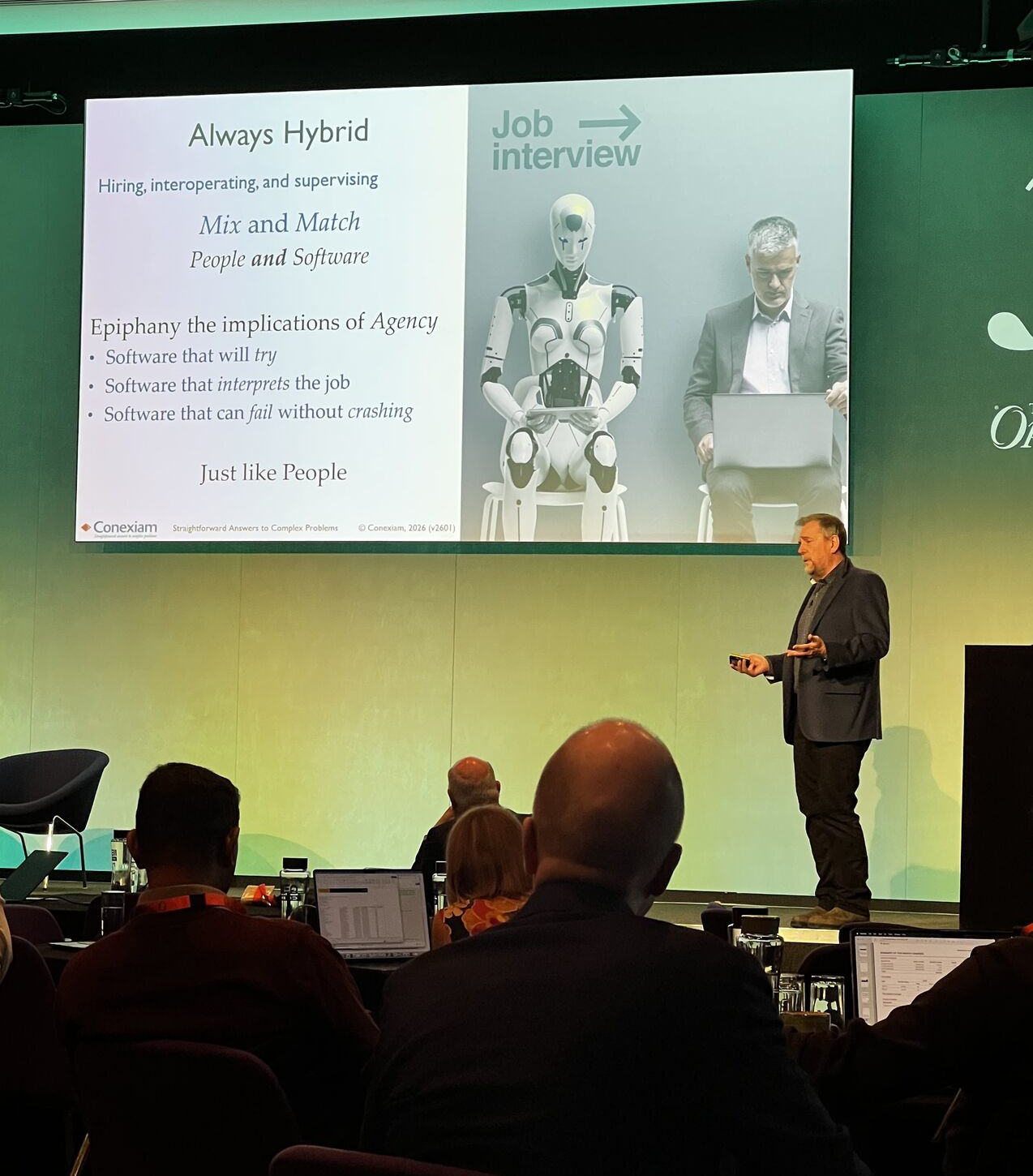
Presentation from The Open Group London, February 2026
In this keynote, Conexiam’s Dave Hornford tackles the central dilemma facing enterprises today: 95% of AI projects fail to impact the bottom line. Why? Because we’re stuck talking about technology, not the work that needs doing.
Dave “flips the script” and argues that the only path to transformative, sticky value is to architect for agency—designing hybrid work areas where people and AI software, as true workers, can interpret, try, and innovate. The alternative is what HBR calls “pilot theatre”: local successes that fail to scale, propped up by the unsustainable “hidden human subsidy.”
In this presentation, you’ll learn:
- The AI Value Crisis: Why most projects don’t scale and benefits fade.
- The Fundamental Pivot: How to stop architecting systems and start architecting work.
- The Power of Agency: Why software that can “try” (like the AI wingman that rolls the plane for a better view) is a different species of worker.
- The Unit of Design: How to use Work Areas—with a boss, a mandate, and governance—as the container for hybrid teams.
- The Path to Sticky Value: How integrated workframe architecture dissolves the business-IT divide and eliminates the hidden subsidies that doom projects.
This is not a talk about personal productivity tools. It’s a strategic guide for enterprise architects and leaders who need to move beyond hype, govern agentic AI, and build a capability for genuine innovation.
Go Further with Best Practice Enterprise Architecture Process and Method
Best practice enterprise architecture from Conexiam Navigate

Developing an Architecture View
Developing an Architecture View Enterprise architecture is an essential compass. It helps organizations navigate the complexities of technology, strategy, and operations. The core of enterprise architecture is a systematic approach. The objective is to ensure […]

Using Scenario Analysis for Enterprise Architecture
Using Scenario Analysis for Enterprise Architecture A scenario is simply a plausible future. Scenario analysis looks at how we get to a plausible future and how different scenarios impact our current choices. Scenarios help leaders […]

Discover the Power of Enterprise Architecture Patterns
Discovering the Power of Enterprise Architecture Patterns: A Comprehensive Guide Every organization wants to improve. Streamline their operations. Enhance their enterprise agility. Align change with their strategies. Succeed at digital transformation. Enterprise Architecture, a discipline […]

Developing Enterprise Architecture Strategy
Developing Enterprise Architecture Strategy: Strategic Plan for Change Enterprise Architecture Strategy is action. Action your organization will take and the changes you will make to reach your strategic goals. Strategy development is all about choice. […]

Enterprise Architecture Work Management
Enterprise Architecture Work Management Enterprise Architecture Work Management is crucial to the day-to-day success of an Enterprise Architecture Team. Architects must deliver useful guidance before stakeholders make informed decisions. Enterprise architects need to translate the […]

Making Smarter Choices: Why Your Business Needs Architectural Decisions
Making Smarter Choices: Why Your Business Needs Architectural Decisions Enterprises are constantly confronted with the challenge of making crucial decisions. Every day, decisions, including operational practices and technology selections, have a significant impact on a […]

Unlocking the Power of Capability-Based Planning: A Quick Guide
Unlocking the Power of Capability-Based Planning: A Quick Guide Are you looking for a more effective way to plan and execute your business strategy? Look no further than capability-based planning. Identifying and using your organization’s […]

Understanding Enterprise Architecture and Agile
Understanding Enterprise Architecture and Agile Both agile and enterprise architecture are designed to reduce risk. Agile software development excels at building something that we have never had before and do not know how to build. […]

Enterprise Architecture Roadmap as Design
Enterprise Architecture Roadmap as Design An Architecture Roadmap is a planning tool that helps an organization’s decision-makers. A dynamic Architecture Roadmap is designed to help them develop and travel the best path forward. It also […]

Standing-up a Modern Architecture Review Board
Standing-up a Modern Architecture Review Board Standing-up an modern architecture review board requires creating a dynamic governance process and establishing a top-level back-stop decision-making body. The objective is to establish effective architecture governance without bureaucracy. […]
Enterprise Architecture Training and TOGAF Training

Effective Online Education
Effective Online Education Effective online education works. Students to access the best available instructor. Students control the pace of their learning. Instructors can share rich supplemental material without distracting from the primary topic. Effective distance […]

Enterprise Architect’s Kickstart
Enterprise Architect’s Kickstart We need to keep our skills current. More now than ever. Use the Enterprise Architecture Kickstart to improve your ability to deliver transformative enterprise architecture. This 90-day kick-start is how Conexiam Consulting […]

TOGAF Enterprise Architecture Training Course
Do you want training for TOGAF Certification? Demonstrate your knowledge of enterprise architecture with TOGAF Certification TOGAF® Enterprise Architecture Training Course Take a major step to be a better enterprise architect with TOGAF Standard, 10th […]

Custom Enterprise Architecture Training
Custom Enterprise Architecture Training Custom enterprise architecture training addresses the professional development your EA Team needs. Good enterprise architects use a broad set of skills, method, in addition to specialized domain knowledge to develop enterprise […]

Business Architecture Training Course
Business Architecture Training Effective enterprise architecture relies on business architecture. The course gives students the skills and knowledge to develop business architecture in an enterprise architecture setting. Business architecture involves describing the structure of the […]

Avolution ABACUS Training Course
Avolution ABACUS Training Effective enterprise architecture relies on formal modeling and analysis. We provide Avolution ABACUS training from hand-on enterprise architects. Students gain skills and knowledge to create integrated enterprise and domain architectures in this […]

Stakeholder Engagement Workshop
Stakeholder Engagement Workshop Stakeholder Engagement Workshops start your architecture development on a firm footing. Understand your key stakeholders, their concerns, how to engage, and how to communicate. Get Help to Start Today Stakeholder Engagement Workshop […]

Data Architecture Foundation Workshop
Data Architecture Foundation Workshop Data Architecture Foundation Workshops develop string foundations for your data architecture. Used to set the state for Data Governance Initiatives and Data Initiatives. Understand your data landscape – what are the […]

Enterprise Architecture Governance Workshop
Enterprise Architecture Governance Workshop Enterprise Architecture Governance Workshops ensure your architecture project and implementation project have the architecture governance to succeed. You do not have time time to run failed improvement efforts. Enterprise Architecture Governance […]
Enterprise Architecture Capability Workshop
Enterprise Architecture Capability Workshop The Enterprise Architecture Capability Workshop starts with your enterprise architecture use case and develops an improvement roadmap for your EA Team. The Enterprise Architecture Capability Workshop results in a designed EA […]
Initiative Strategy Workshop
Initiative Strategy Workshop Initiative Strategy Workshops develop a strategy for an initiative. Used for new initiatives, and initiatives that have stumbled. Understand what actions are available to reach the outcome. Be able to articulate the […]
Scenario-Based Architecture Roadmap Workshop
Scenario-Based Architecture Roadmap Workshop Scenario-Based Architecture Roadmap Workshops develop candidate architecture roadmaps using scenario analysis. Scenario analysis tied together with architecture roadmaps are powerful tools when used early in architecture development. When you need to […]
Conclusion
We have been been deeply immersed in the evolving landscape of AI Adoption, engaging in a journey encompassing both technical intricacies and broader digital transformation.
The Agentic AI Architecture Playbook stems from our work to refine our core tools. Most of Navigate is internal and lightly documented—we rely on a Conexiam partner to fill in the details. Other parts, like the Seven Levers of Digital Transformation require skills to apply. Last, parts like the Capability-based Planning Guide, are well developed.
The Agentic AI Architecture Playbook is among our most developed and repeatable assets.
Develop your Agentic AI Architecture skills with an architecture approach.
