
In normal times, our business ecosystem, business model, product and service families, and how we work together—organigraphic—just are. Few even think about the landscape.
Every business architect and enterprise architect thinks about our business architecture. The contours found in the simple business model kind and product and service model kind establish a lot of superior architecture. There is a huge difference between the foundational design of Tesla and Toyota. Toyota deeply engages suppliers to make most of a car. Tesla almost redesigns electricity in their push to put advanced technology everywhere.
These rough contours set a frame—deep external engagement vs. vertical integration—but only a frame. They do not go far enough. We need more detail. Especially about the core of our business, our products and services. We must understand how to optimize our enterprise architecture to value.
The IT professionals I work with often struggle to understand value. Often, I see them using value as a synonym for whatever was delivered. Every time I can feel my Six Sigma senses snapping to attention, hollering 'What? A random work product is not value!' When this happens, I'll ask a few questions. Inevitably it's clear they are lost. Unable to articulate what is valuable, let alone why it's valuable.
Let's lay down a few hard lines in the sand. First, value is something a customer will pay extra for, or if it is missing refuse to purchase.
- Something the customer will pay extra for
- Something the product needs to be considered for purchase
Second, everything we do to create value is important. Everything else is waste. Six Sigma goes further and states that the starting assumption is everything not proven to be optimized to create value is waste.
- Everything not proven to be optimized to create value is waste
Given waste is inevitable, our job is to minimize waste while optimizing for value. If it was an easy task of optimizing for one variable without fussing over superior architecture constraints, we wouldn't need the overhead of enterprise architecture or EA frameworks.
The key question—what is this value we are optimizing for? Our journey to Navigate's second set of business architecture models will help us see value delivery as directions. We use the value chain configuration, products and services, and product family specific business models to do two things. Provide the guidance of what creates value, and catalogue what is guaranteed waste.
This week, we'll look into the value chain model kind and understand the power of reference architectures and configuration choices.
Your business can always paint the sky green

Introducing a Value Chain
We love reference architectures! Reference architectures are the ultimate intellectual accelerator! A reference architecture takes a topic and identifies the normal outlines of a system. It provides a conceptual shell for the system.
More importantly, someone else made it, hundreds of others have refined it. It has proven itself over time. We can lean on it and it will carry the load.
The classic Porter Value Chain is a reference architecture. It takes a commercial organization and identifies the normal outline. Primary Activities create the products and services that delight our customers. Supporting activities—drawn as a burden Primary carries—exist because they are necessary and do not delight our customers.
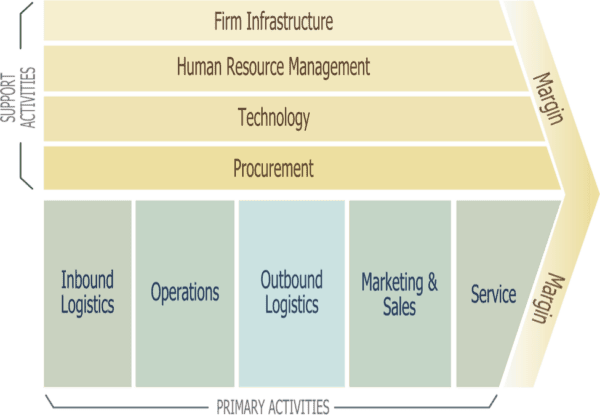 A solid value-centric thinking frame. Supporting Activities (overhead) and Primary Activities (value producing). All aligned to capture margin.
Great reference architectures show Structure (components and relationships) and Function (how the system works).
Michael says structure and function are tied to business activities. The things a business must do. He uses a simple graphic to draw our eye to overhead and the movement of raw materials into our organization and out to our customer. With a simple arrow, we know the goal is generate margin.
All reference architectures explicitly, or implicitly, explain the scope of the system of interest—what is the boundary of analysis. And what is the problem.
The Porter Value Chain says the scope is the activities necessary to operate a commercial organization. The problem, optimization for margin.
My EA consulting team looks for perfectly complete reference architectures. We know, few include everything we desire:
- Model(s) of the system showing Components, Relationships between components, and Properties that should be specified
- A crisp vocabulary containing every specialized term and phrase, all consistently defined
- Relevant architecture patterns
- Guiding architecture principles
- Viewpoint Library
Most volunteers creating useful reference architectures create one good enough for their purposes. Then they stop. In 1985 Michael stopped.
You see the 1980s manufacturing roots in Michael's model. When he was thinking, digital products were not a thing. Nor, the rich ecosystem of outsourcers.
However, none of this changes the power of the core structure:
- Primary delights your customers
- Supporting provides scale and efficiency to do what Six Sigma calls unavoidable waste
- Everything is about the activities
I use the basic Porter Value Chain all the time. In the search for better tools I read pundits' calls claiming a need for redoing, refreshing, and modernizing. When I read their complaints, all I see is a call for an industry-specific variant.
Of course we all want an architecture project specific reference architecture. Who doesn't want the boundary of analysis, core components, and central problem handed to them? This is why my EA consulting team is always on the look-out for strong reference architectures. When we find one we render it in Navigate's formal model terms and drop it into our EA Repository. Where it waits quietly, until we need to accelerate our thinking.
Configuring a Value Chain
Most industries have a common value chain. A common set of activities everyone in the industry makes choices about. After all, Tesla and Toyota do the same thing, make cars. Making cars requires designing cars, sourcing raw materials and parts. Manufacturing the car. Distributing the car. Retail sales. Maintenance and support.
The difference is how companies have made different configuration choices about the common activities. Those choices dance at the cusp of being hard foundational constants and variables.
Think about Tesla and Toyota. Both made radically different foundational choices. Tesla does things in-house. Toyota uses close supply partners. When Tesla's truck needed a new manufacturing technique—bent stainless steel body panels—Tesla invented the process, the tools, and built a facility. Tesla does things in-house.
By contrast, when Toyota needs something, they look outside. Toyota instinctively looks for a specialist supplier. Toyota uses third party dealers to sell and service. Tesla, again in house. To the extreme of fuelling the car—Tesla invented a better electric plug, built a network of best-in-class facilities, and added an entire software suite tied to each car's navigation providing real-time advice to the entire fleet about when and where to refuel.
Value Chain Model Kind
Whenever I am working on an architecture project I must know my current business architecture. Starting with the contours. Then the detail of our value chain configuration.
What I am hunting for are the primary value-creating activities, and their interrelationships. I want to find the configuration choices my organization made.
Then I need to see the supporting activities, their relationships, and their engagement with the primary.
At this point, I'll exclude process logic, and capability definitions. I want high-level activity flows, and a sense of the organizational design under the hood.
In Navigate we'll model this through a hierarchical activity decomposition. I'm seeking a simple Porter-like diagram that illustrates how value is created and supported.
We lean on a few architecture properties to help pull out configuration choices:
- Value Chain State identifies Primary or Supporting. I need to know whether I'm optimizing for value creation or for efficiency. Remember, by Six Sigma definition all supporting activity is waste, and we need to minimize the spend on waste.
- Performer identifies who does the activity. I look for corporate or divisional teams, an acquisition, a business partner, a vendor or a customer.
- Competency compares with our peers. We score Parity, Advantage, Superior. I want to know where we are investing for differentiation, and what that differentiation is.
- Operating Model leverages MIT's CISR. Knowing which activity is Diversified, Unified, Replicated, or Coordinated tells us about the expected deployment. I can infer how that deployment aligns to value.
Sometimes I'll reach to Maturity, where a strict reading of CMMI's 1-5 scale tells me about the required control of the activity. Remember, CMMI-based maturity is never a measure of goodness.
Concluding Permission to Be Different
Leaping off the page of my Value Chain Model are crisp, clear, definitive directions—performance expectations, constraints, and risk appetite.
An activity that is Primary, performed product-specific, and Diversified must be optimized for the specific needs of the Product. Pairing distinct performers and diversified is a strong push. Not only do we have duplicate activity, but it is expected to be done differently. And done with no expectation this activity will connect to anything outside the product. Suggestions about efficiency from scale, and the cost of duplication are violating superior architecture. Yes, they are non-compliant.
Diversified, Replicated, and Coordinated are strong modifiers on locally performed activity. Replicated tells us everyone does the same thing, the same way. Think check-in across all the properties and brands in the Marriott family. Coordinated tells us everyone optimizes process for their product, but shares information for the customer. Think airline check-in across First Class, Business Class, and Economy.
By contrast, an activity that is Primary, Corporate, and Unified must be optimized to the value creation of every product and service at the same time. Here corporate and unified do not tell us much. The default position of a corporate function is to do it the same way for everyone. This one is fun, because unlike a Supporting Unified Corporate activity, I need to optimize for value creation, not efficiency. Arguably I could be inefficient if, and only if it improved value creation.
Let's take a moment to put these cases in terms of our example CEO's expectations:
- Product Family A current market share is too low. Given the value offered there should be more customers. She expects the value already offered to turn into more sales.
- Product Family B product prices are too low. Given the value offered customers should be willing to pay more. She expects the value already offered to turn into more money.
- Product Family C cost of goods is too high. Given the value offered the company isn't making enough profit. She expects to retain larger share of the customer's sense of value.
Let's imagine an activity all three do that is Primary, performed product-specific, and Diversified. Sweet. In Product Family C, we perform a quick test of contribution to Cost of Goods and the ability to slash without impacting product value. A plausible yes to this test puts the activity in the crosshairs.
Now an activity that is Primary, Corporate, and Unified. Sweet. Here we look at that activity in terms of market share, price, and cost. If the activity can move the bar on any of these axes, it is in the crosshairs.
If you have ever wondered about a business architect working in Phase A, wonder no more. If the business architect simply leverages the enterprise value chain and the stated objective of our three architecture projects they have a sense of where to start. They can start to compose viable summary architecture alternatives. They have the information to make some informed calls.
The configuration choices are telling them about the available decision freedom. That cost-impacting, product-specific, diversified activity is under the control of the boss of Product Family C. My first call would be to my application architect and data architect to see if anyone entangled this product-specific diversified activity in the information systems layer. My second call would be to my Product Family C SMEs, who I'd expect would already be considering a radical cost saving exercise.
My third step would be back to the architecture. No one needs my deep expertise to snatch ripe-low-hanging-fruit off the branch. That Primary, Unified and Corporate activity has wicked problem written all over it. Enterprise architect skills are needed to untangle that complex decision space to squeeze some marketshare & price boost, while driving down cost of goods.
This week I want you to think about the edge of superior architecture. Last week, we discussed the deep contours of our superior architecture. This week, we reached the transition zone between superior architecture and open variables. That independently product-specific activity has a burden of producing enough value to justify inefficiency.
My challenge is for you to sketch your value chain and your most prominent competitor's value chain. You should see the same activities, often with similar choices. Then sketch another industry player who isn't a direct competitor, you'll probably see different configuration choices.
As a stretch goal, write down the end-to-end system supporting those activities. I suspect you will see the roots of friction where value chain choices are in conflict with choices inside the end-to-end system. Every one of those friction points is a wicked problem calling for enterprise architect skills.
In my example, I read from the business architecture to understand the configuration choices. Then I quietly slipped past the definition of value by telling you to optimize. I had to. I needed you to think about the value chain and configuration choices. Those choices exist and must be optimized to the value proposition. Bluntly, there is a reason why one activity is corporate unified and another performed independently by every product. Next week we'll move from the configuration choices to understanding the value proposition.
Have a great week!
As always, I welcome your feedback and questions.
Regards,
Dave
Dave Hornford
Conexiam

Agentic AI Playbook Conversations
Agentic AI Playbook Conversations We have been been deeply immersed in the evolving landscape of AI Adoption, engaging in a journey encompassing both technical intricacies and broader digital transformation. We developed the Business Leader’s Guide […]

Download AI Adoption Critical Capability Reference Architecture
Download AI Adoption Critical Capability Reference Architecture AI Adoption requires innovation thinking. Today we do not have proven best-practices for widespread AI Adoption that consistently improve our organizations. We require the ability to re-imagine our […]
Download Business Leader’s Guide to AI
Download Business Leader’s Guide to Artificial Intelligence Organizations that successfully apply innovative technology have had a competitive advantage. Innovative technology does not come with established success patterns and best practices. Innovative technology is novel and […]

Download the Introduction to the TOGAF Standard, 10th Edition
Download Introduction to the TOGAF® Standard, 10th Edition The TOGAF Standard, 10th Edition makes adoption of enterprise architecture best practices easier. It separates the universal concepts from proven best practice. The standard underscore where to […]

Download Capability-based Planning Guide
Download Capability-based Planning Guide Always drive to realize value. Half an improvement is 100% waste! No one teaches an Eagle to crawl, walk, or run. Eagles Fly! Download Teach your Eagles to Fly: Capability-based Planning […]

Download Business Architecture Capability Assessment Guide
Download Business Architecture Capability Assessment Guide Download a Business Architecture Capability Assessment Guide. Capability-based planning is one of the most powerful business architecture improvement techniques. Best practice of capability-based planning uses capability as a management […]

Download Sample Enterprise Architecture Principles
Download Sample Architecture Principles Download a sample enterprise architecture principles. Enterprise Architecture principles identify how to approach a problem or decision. The approach always drives you towards your enduring priorities. Download Sample Enterprise Architecture Principles […]

Download Enterprise Architecture Governance Guide
Download Enterprise Architecture Governance Guide Download the Enterprise Architecture Governance Guide to understand best practice to direct and control the development of architecture, and change to obtain the expected outcomes. Download Enterprise Architecture Governance Guide […]

Download TOGAF and SABSA Integration
Download TOGAF and SABSA Integration Bring SABSA, the world’s best security architecture framework, and TOGAF, the industry standard enterprise architecture framework together. Download TOGAF and SABSA Integration TOGAF and SABSA Integration Includes SABSA uses a […]

Download Enterprise Architecture Capability Reference Architecture
Download Enterprise Architecture Capability Reference Architecture The Enterprise Architecture Capability Reference Architecture will speed up establishing and enhancing your EA Team. Design your Enterprise Architecture Team for success. Identify and enhance the your enterprise architecture […]
Enterprise Architecture Training and TOGAF Training

Effective Online Education
Effective Online Education Effective online education works. Students to access the best available instructor. Students control the pace of their learning. Instructors can share rich supplemental material without distracting from the primary topic. Effective distance […]

Custom Enterprise Architecture Training
Custom Enterprise Architecture Training Custom enterprise architecture training addresses the professional development your EA Team needs. Good enterprise architects use a broad set of skills, method, in addition to specialized domain knowledge to develop enterprise […]

Avolution ABACUS Training Course
Avolution ABACUS Training Effective enterprise architecture relies on formal modeling and analysis. We provide Avolution ABACUS training from hand-on enterprise architects. Students gain skills and knowledge to create integrated enterprise and domain architectures in this […]

TOGAF Enterprise Architecture Training Course
Do you want training for TOGAF Certification? Demonstrate your knowledge of enterprise architecture with TOGAF Certification TOGAF® Enterprise Architecture Training Course Take a major step to be a better enterprise architect with TOGAF Standard, 10th […]

Business Architecture Training Course
Business Architecture Training Effective enterprise architecture relies on business architecture. The course gives students the skills and knowledge to develop business architecture in an enterprise architecture setting. Business architecture involves describing the structure of the […]

Enterprise Architect’s Kickstart
Enterprise Architect’s Kickstart We need to keep our skills current. More now than ever. Use the Enterprise Architecture Kickstart to improve your ability to deliver transformative enterprise architecture. This 90-day kick-start is how Conexiam Consulting […]
Go Further with Best Practice Enterprise Architecture Process and Method
Best practice enterprise architecture from Conexiam Navigate

Developing Enterprise Architecture Strategy
Developing Enterprise Architecture Strategy: Strategic Plan for Change Enterprise Architecture Strategy is action. Action your organization will take and the changes you will make to reach your strategic goals. Strategy development is all about choice. […]

Standing-up a Modern Architecture Review Board
Standing-up a Modern Architecture Review Board Standing-up an modern architecture review board requires creating a dynamic governance process and establishing a top-level back-stop decision-making body. The objective is to establish effective architecture governance without bureaucracy. […]

Unlocking Your Business Potential: How to Create an Effective Capability Map
Unlocking Your Business Potential: How to Create an Effective Capability Map Are you struggling to identify the capabilities needed to take your business to the next level? Do you find it challenging to align resources […]

Unlocking the Power of Capability-Based Planning: A Quick Guide
Unlocking the Power of Capability-Based Planning: A Quick Guide Are you looking for a more effective way to plan and execute your business strategy? Look no further than capability-based planning. Identifying and using your organization’s […]

Enterprise Architecture Roadmap as Design
Enterprise Architecture Roadmap as Design An Architecture Roadmap is a planning tool that helps an organization’s decision-makers. A dynamic Architecture Roadmap is designed to help them develop and travel the best path forward. It also […]

How to Define Enterprise Architecture Principles
How to Define Enterprise Architecture Principles To Define Enterprise Architecture Principles start with understanding what a principle is and how to apply them. Then we can develop strong architecture principles that help improve our organization. […]

Using Scenario Analysis for Enterprise Architecture
Using Scenario Analysis for Enterprise Architecture A scenario is simply a plausible future. Scenario analysis looks at how we get to a plausible future and how different scenarios impact our current choices. Scenarios help leaders […]

Everything You Need to Know About Using Architecture Alternatives
Everything You Need to Know About Using Architecture Alternatives Architecture alternatives are required for good enterprise architecture development. When you start architecture development, your enterprise has deficiencies. There are areas for improvement. You need to […]

Making Smarter Choices: Why Your Business Needs Architectural Decisions
Making Smarter Choices: Why Your Business Needs Architectural Decisions Enterprises are constantly confronted with the challenge of making crucial decisions. Every day, decisions, including operational practices and technology selections, have a significant impact on a […]

Understanding Enterprise Architecture and Agile
Understanding Enterprise Architecture and Agile Both agile and enterprise architecture are designed to reduce risk. Agile software development excels at building something that we have never had before and do not know how to build. […]

Data Architecture Foundation Workshop
Data Architecture Foundation Workshop Data Architecture Foundation Workshops develop string foundations for your data architecture. Used to set the state for Data Governance Initiatives and Data Initiatives. Understand your data landscape – what are the […]
Scenario-Based Architecture Roadmap Workshop
Scenario-Based Architecture Roadmap Workshop Scenario-Based Architecture Roadmap Workshops develop candidate architecture roadmaps using scenario analysis. Scenario analysis tied together with architecture roadmaps are powerful tools when used early in architecture development. When you need to […]
Enterprise Architecture Capability Workshop
Enterprise Architecture Capability Workshop The Enterprise Architecture Capability Workshop starts with your enterprise architecture use case and develops an improvement roadmap for your EA Team. The Enterprise Architecture Capability Workshop results in a designed EA […]

Stakeholder Engagement Workshop
Stakeholder Engagement Workshop Stakeholder Engagement Workshops start your architecture development on a firm footing. Understand your key stakeholders, their concerns, how to engage, and how to communicate. Get Help to Start Today Stakeholder Engagement Workshop […]

Enterprise Architecture Governance Workshop
Enterprise Architecture Governance Workshop Enterprise Architecture Governance Workshops ensure your architecture project and implementation project have the architecture governance to succeed. You do not have time time to run failed improvement efforts. Enterprise Architecture Governance […]
Initiative Strategy Workshop
Initiative Strategy Workshop Initiative Strategy Workshops develop a strategy for an initiative. Used for new initiatives, and initiatives that have stumbled. Understand what actions are available to reach the outcome. Be able to articulate the […]
