

What is Business Architecture?
Business architects develop a business architecture to translate the complexity of an organization into a form that can be analyzed. The analysis allows the business architect to understand the source of an issue, and how to improve the enterprise. The business architecture assists stakeholders select and govern improvements.
This simple explanation can be expanded.
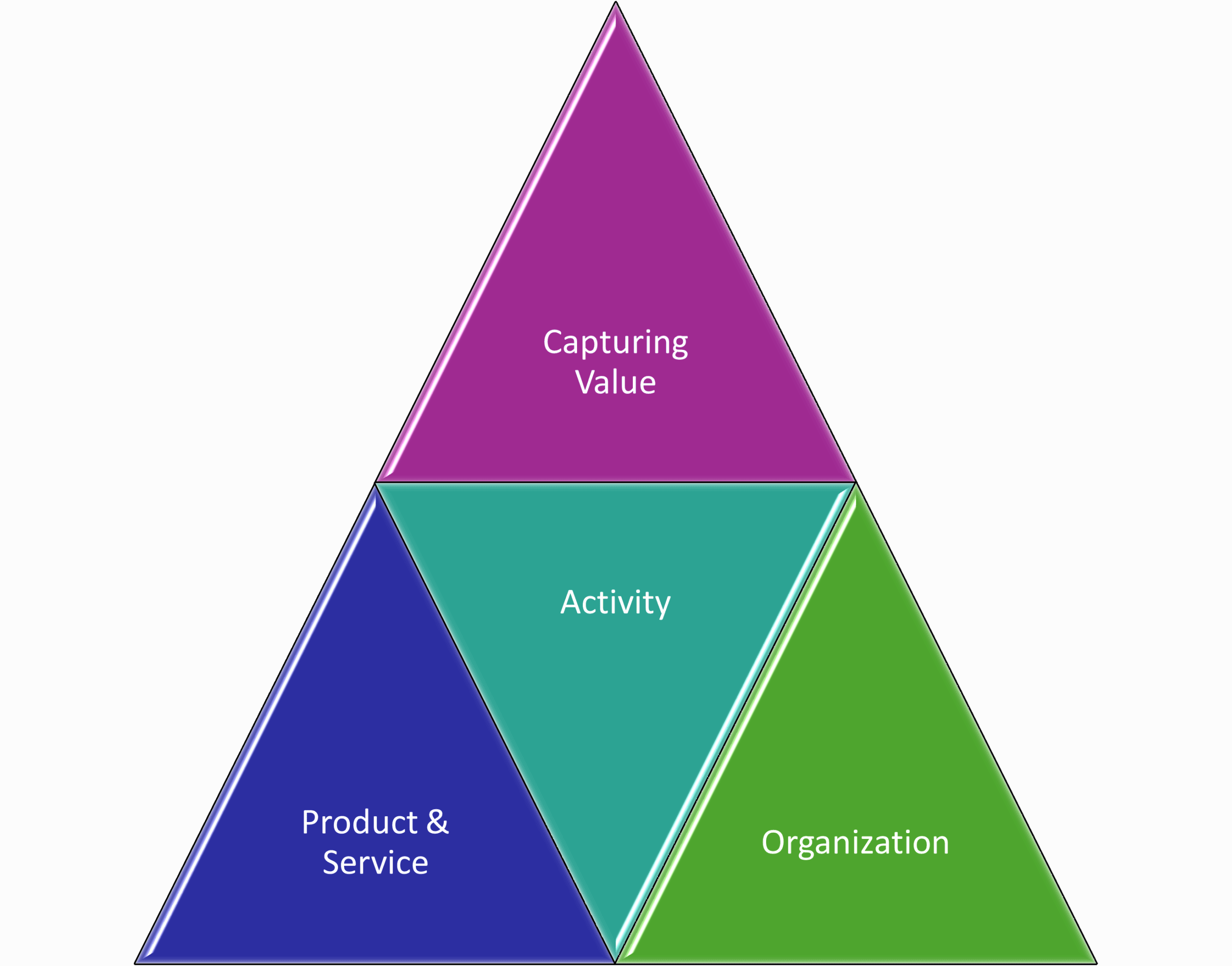
All business architecture is focused on activity — what the business does. Activity revolves around the organization's products & services. Activity and product are optimized to the creation and capture of economic value. Last, how the organization is structured.
Business architecture is one architecture domain that comprise the complete enterprise architecture.
Any idea that the business architect exists to send requirements to IT systems is laughable in a modern digital enterprise. Improving a digital enterprise must be done together with the data architecture and application architecture.
Developing an architecture means developing models. Navigate uses three sets of models:
- Context Models—that describe the enterprise context
- Value Models—the describe how the organization creates and captures value
- Exploring Change Models—the explore how to improve the enterprise
What is Business Architecture
Business Architecture is one part of a complete enterprise architecture. It is used to guide change, and serves as a foundation for all other domains.
Whether to change & what to change?
How to change?
What to leave alone?
How to deal with failing change?
You use business architecture when you have a wicked problem. Problems that defy simple apple-to-apples comparison or consistent selection criteria.

Data Architecture Foundation Workshop
Data Architecture Foundation Workshop Data Architecture Foundation Workshops develop string foundations for your data architecture. Used to set the state for Data Governance Initiatives and Data Initiatives. Understand your data landscape – what are the […]

Enterprise Architecture Governance Workshop
Enterprise Architecture Governance Workshop Enterprise Architecture Governance Workshops ensure your architecture project and implementation project have the architecture governance to succeed. You do not have time time to run failed improvement efforts. Enterprise Architecture Governance […]
Initiative Strategy Workshop
Initiative Strategy Workshop Initiative Strategy Workshops develop a strategy for an initiative. Used for new initiatives, and initiatives that have stumbled. Understand what actions are available to reach the outcome. Be able to articulate the […]

Stakeholder Engagement Workshop
Stakeholder Engagement Workshop Stakeholder Engagement Workshops start your architecture development on a firm footing. Understand your key stakeholders, their concerns, how to engage, and how to communicate. Get Help to Start Today Stakeholder Engagement Workshop […]

Enterprise Architecture Capability Workshop
Enterprise Architecture Capability Workshop The Enterprise Architecture Capability Workshop starts with your enterprise architecture use case and develops an improvement roadmap for your EA Team. The Enterprise Architecture Capability Workshop results in a designed EA […]

Scenario-Based Architecture Roadmap Workshop
Scenario-Based Architecture Roadmap Workshop Scenario-Based Architecture Roadmap Workshops develop candidate architecture roadmaps using scenario analysis. Scenario analysis tied together with architecture roadmaps are powerful tools when used early in architecture development. When you need to […]
Four Elements of Business Architecture
Every business architecture will address:
These elements focus our understanding one the most important aspects of your organization—how it captures value and its products and services, long lasting organizational structures, and what work it does.
We want to understand where the organization is not optimized—specifically where we are not optimized for value creation and capture.
We know that in a modern digital enterprise the business architecture, application architecture and data architecture must enhance each other. Together you have the core of a great enterprise architecture.
A solid understanding of the enterprise architecture allows use of powerful techniques like Capability Based Planning to drive an effective roadmap.
Activity
Business architecture rotates around activity—the things your organization does.
Activity falls into four groups:
- Activity that creates and captures value: Designing, making, selling, supporting your products and services. Think of Porter's Primary Value Chain.
- Activity that is important, and supports value capture: Hiring, payroll, facility management, taxes, paying your bills, etc. This is the back office, all the activity that keeps your business running. Think of Porter's Supporting Value Chain.
- Activity needed to manage other work: Scheduling, task management, and coordination. Everything necessary for a well managed high efficiency organization. It is often overlooked when we talk about the work.
- Activity that changes your organization: Storing, retrieving, mixing, evaluating, moving and securing the data.
You need to have n understanding of the activity your business needs performed. In most of our models we distinguish who, or what, does the activity. Activity can be performed by different divisions, subsidiaries, customers, business partners, suppliers, and increasingly automated systems.
When we overlook activity to manage and change. When we do, we lose control of our future. Organizations with high enterprise agility excel at management and change.
Activity expressed in the Logical Process Model.
Product and Service
We need to know what we are in business to do. Produce petroleum, re-insure, dispose of construction waste, or curate media. Our businesses do something We have to understand the products and services delivered to our customers, and where we fit in our industries value streams.
Products and Services are described in the Product & Service Model.
Create and Capture Value
We need to know how we create value, and capture value. Creation and capturing value is tied to our products and services, but is distinct.
For example, a firm that manufactures and sells its products can create value in design,manufacturing, support, or customer experience. Simply consider the difference between Apple and Dell.
Organization
For thousands of years the organization model has played a critical role in performance. In modern times Conway's Law. At a minimum we need to understand the structure we work within. Ideally, we have another element we can adapt in the target architecture.
The organizational model, organigraph model, ecosystem, and authority models will explain the complete enterprise organization.
Products and Services are described in the Product & Service Model.

Agentic AI Playbook Conversations
Agentic AI Playbook Conversations We have been been deeply immersed in the evolving landscape of AI Adoption, engaging in a journey encompassing both technical intricacies and broader digital transformation. We developed the Business Leader’s Guide […]

Download AI Adoption Critical Capability Reference Architecture
Download AI Adoption Critical Capability Reference Architecture AI Adoption requires innovation thinking. Today we do not have proven best-practices for widespread AI Adoption that consistently improve our organizations. We require the ability to re-imagine our […]
Download Business Leader’s Guide to AI
Download Business Leader’s Guide to Artificial Intelligence Organizations that successfully apply innovative technology have had a competitive advantage. Innovative technology does not come with established success patterns and best practices. Innovative technology is novel and […]

Download the Introduction to the TOGAF Standard, 10th Edition
Download Introduction to the TOGAF® Standard, 10th Edition The TOGAF Standard, 10th Edition makes adoption of enterprise architecture best practices easier. It separates the universal concepts from proven best practice. The standard underscore where to […]
Download Capability-based Planning Guide
Download Capability-based Planning Guide Always drive to realize value. Half an improvement is 100% waste! No one teaches an Eagle to crawl, walk, or run. Eagles Fly! Download Teach your Eagles to Fly: Capability-based Planning […]

Download Business Architecture Capability Assessment Guide
Download Business Architecture Capability Assessment Guide Download a Business Architecture Capability Assessment Guide. Capability-based planning is one of the most powerful business architecture improvement techniques. Best practice of capability-based planning uses capability as a management […]

Download Sample Enterprise Architecture Principles
Download Sample Architecture Principles Download a sample enterprise architecture principles. Enterprise Architecture principles identify how to approach a problem or decision. The approach always drives you towards your enduring priorities. Download Sample Enterprise Architecture Principles […]

Download Enterprise Architecture Governance Guide
Download Enterprise Architecture Governance Guide Download the Enterprise Architecture Governance Guide to understand best practice to direct and control the development of architecture, and change to obtain the expected outcomes. Download Enterprise Architecture Governance Guide […]

Download TOGAF and SABSA Integration
Download TOGAF and SABSA Integration Bring SABSA, the world’s best security architecture framework, and TOGAF, the industry standard enterprise architecture framework together. Download TOGAF and SABSA Integration TOGAF and SABSA Integration Includes SABSA uses a […]

Download Enterprise Architecture Capability Reference Architecture
Download Enterprise Architecture Capability Reference Architecture The Enterprise Architecture Capability Reference Architecture will speed up establishing and enhancing your EA Team. Design your Enterprise Architecture Team for success. Identify and enhance the your enterprise architecture […]
Navigate Business Architecture Model Kinds
Navigate is designed to support specific models, and build an end-to-end architecture model. We separate these models to allow us the benefit of modelling something specific, then using the observation of that model elsewhere. We do not force an end-to-end model.
We create this benefit through through discrete model kinds. A model kind can support specific analysis, or focus on a separate aspect of the end-to-end model. In simple terms, a model kind is a specific type of modelling.
Your architecture project will identify which architecture models you need. Different models explain the enterprise in a different way. Taken together, the models describe the business architecture.
The business architecture has three groups of business architecture model kinds.
- Organizational Model
- Organigraph Model
- Ecosystem Model
- Asset Model
- Authority Model
- Business Model
- Operating Model
These specialized models combine to develop the EA Landscape following the best practice of incrementally extending it one architecture project at at time.
Using model kinds drive consistency and re-usability driving productivity and consistency across an EA Team.
Navigate Model Kind Description
Each model kind is defined by:
- Purpose: Why this model kind exists and what questions it's intended to answer.
- Scope: Outlining the boundaries of what’s included and excluded within the model kind.
- Content & Structure: The components, relationships, and properties that should be used when creating instances of a model kind.
- Modelling Approach: Guidance on how what is included or excluded to focus on specific aspects relevant to the objectives.
- (Optional) Relationship with other Model Kinds: Describes the purpose of the link and what relationship is used to bridge the two models.
In the complete enterprise architecture, these models will link to other models that describe the other enterprise architecture domains.
To effectively manage your business architecture, you will need to implement an enterprise architecture tool.
Business Architecture Context Models
Most architecture projects must work within the enterprise context. Business architecture context models provide the enterprise context.
The enterprise context establishes clear, implementation‑agnostic boundaries, stakeholders, interfaces that frame architecture work.
The enterprise context is comprised of:
- its internal structure and reporting lines (Organizational),
- non‑hierarchical operating patterns (Organigraph),
- external partners/regulators/markets (Ecosystem),
- the enterprise’s economic model (Business Model),
- decision making, governance and risk domains (Authority Domain),
- and the key tangible/intangible resources (Assets).
The enterprise context surfaces the organization-specific and external forces that constrain or enable target architecture.
Organizational Model
Represents the structure of organizational units in the enterprise. While focused on internal reporting structures, it will include subsidiaries and business partners.
This model kind supports analysis of change impact, structural barriers, and organizational alignment to strategy.
Organigraph Model
Depicts complex organizational and network relationships beyond traditional hierarchies, illustrating different philosophies of managing and interaction styles (Set, Chain, Hub, Web).
Supports understanding of coordination, control, and collaboration patterns within and across organizational and ecosystem boundaries.
Ecosystem Model
Represents the external and extended enterprise environment.
Uses multiple layers to capture the complexity and diversity of external relationships:
- Regulatory Layer: Regulators, compliance bodies, standards organizations, and their rules, controls, and reporting interactions
- Market Layer: Competitors, customers, market influencers, and demand-side dynamics
- Upstream Business Partner Layer: Suppliers, logistics providers, and upstream collaborators critical to inputs and production
- Downstream Business Partner Layer: Distributors, resellers, service partners, and other channels delivering products/services to end customers
- Internal Layer: Organizational, functional, and legal structures within the enterprise boundary that interface with external layers
Supports strategic analysis of dependencies, risks, innovation opportunities, and market/regulatory forces.
Business Model
Describes how the enterprise economically captures value articulating the mechanisms, architecture, and rationale of value creation, delivery, and capture.
This model kind focuses explicitly on the enterprise’s perspective of value capture and excludes product-level value propositions or ecosystem-level value perceived externally. For product & product-family value proposition use the Business Model Canvas.
We look for:
- Financial Logic (Value Capture)
How the enterprise captures economic value through revenue generation, pricing models, profit mechanisms, and contractual terms. - Market Scope & Delivery Channels (Value Delivery)
Defines who the enterprise serves (customer segments, markets) and how it delivers value (physical, digital, and partner channels) relevant to value capture. - Operational Logic (Value Creation & Delivery)
Captures Capabilities, Business Functions, and Processes that create and deliver value in support of the enterprise’s economic model. - Enablers & Execution (Value Sustainment & Acceleration)
Represents organizational resources, skills, infrastructure, brand, and accelerators that sustain and enhance ongoing value creation and capture.
Operating Model
Many people confuse how they use an operating model with what an operating model is. An operating model describes how a business structures its core activities. The operating model shows the unique capabilities aligned with the enterprise's strategy, skilled leadership teams, or unique investment profiles.
The Operating model is an anchor for the enterprise. It is critical for the strategy's effectiveness and longevity.
Asset Model
Represents the enterprise’s tangible and intangible valuable resources that hold economic value or strategic importance. Provides a structured view of assets to enable clear ownership, valuation, governance, and alignment with risk and performance expectations.
Includes all significant business assets such as physical infrastructure (e.g., plants, equipment, technology), intellectual property (patents, software, proprietary processes), financial assets, and customers (e.g., contracts and relationships).
Business Architecture Value Models
Value models describe where and how the enterprise creates and captures that value.
Value models create clear requirements, expectations, priorities, and constraints that drive architecture development, trade‑off, and architecture decisions.
The model kinds include:
- the portfolio of products and services,
- the end‑to‑end activities that generate value and their supporting activities (Value Chain),
- the product‑ or service‑level value proposition, target customers, channels, partners, key activities, resources, and revenue/cost logic (Business Model Canvas).
Value models surface the organization‑specific and market forces that reveal value opportunities, risks and trade‑offs, and they drive alignment and prioritization for target architectures.
Product and Service Model
Products and services delivered to customers. Used to define and manage the portfolio of products and services, supporting value assessment, portfolio planning, and alignment to market and capability strategies.
Value Chain Model
Maps the primary and support activities that generate business value, enabling analysis of value creation and alignment with capabilities and processes.
Covers all value-adding activities within the enterprise and their interrelationships. Excludes detailed process logic or capability definitions, focusing on high-level activity flows and value streams.
A classic Porter Value Chain diagram separates supporting activity from primary activity. In a Porter diagram, we always put the supporting activity on the top—all supporting activity are a burden on the primary activity. The primary activity must produce enough customer value to pay for the supporting activities.
We can further break a Value Chain down into pillars or value streams.
Business Model Canvas
Describes the value proposition of a single product, or product family. The value proposition is directly tied to how it is delivered to a target customer and what key activities, partners, and resources are necessary.
The Business Model Canvas works best when developed for individual products or services rather than entire enterprises.
Exploring Business Architecture Change Models
Most architecture projects must guide effective change. Navigate’s Business Architecture Change models focus on the most malleable elements to discover and describe how the enterprise must evolve. Change modelling starts by translating strategy and capability shortfalls into candidate target states and prioritized work packages; stakeholder approval then enables an architecture roadmap
Model kinds include:
- Logical Process Model — the logical flows of work that define how business functions are performed (what is done, not how)
- Logical Business Service Model — the consumer‑centric, outcome‑focused services that define how the organization can be assembled to deliver those outcomes (boundaries, interaction points, terms of use/change).
- Capability Model Kind — the stable abilities the enterprise must develop, improve or sustain to deliver strategy and value
- Information Model — key Information artifacts in the Subject Area Model and Logical Document Model
Change models expose gaps, constraints, risks and dependencies, and provide the traceability and prioritization needed to plan roadmaps, work packages and architecture specifications that realize target architectures.
Logical Process Model
The Logical Process Model defines how core business functions (e.g., Order-to-Cash) are performed within the enterprise. It captures the logical flow of work—independent of how it is implemented.
This model focuses on the logical sequence of activities that realize enterprise business functions. It is used to understand and evaluate what work is done, not how it is executed in practice.
The Logical Process Model is often related to a Logical Application Model, and either the Subject Area Model or Logical Data Model.
Business Service Model
The Logical Business Service Model Kind helps you understand how how an organization can be assembled.
Every Logical Business Service provides something, how is left out of this consumer-centric model. Instead this model focused on operational interaction, terms of use, and terms of change.
Key values include:
- Defining Boundaries: Identifying where a service begins and ends, and what it is responsible for
- Clarifying Interaction Points: Required interoperability points
- Consumer-Centric Modeling: Emphasizes the consumer’s perspective - what they get by using a 'black box' Service, and the constraints they accept to use the service (terms of use and terms of change)
- Defining Contract Terms: terms of use (what constraints apply to using the service), terms of change (ability of the provider to change the service), terms of access (how to access the service), and outcome (what the service delivers)
Capability Models
The Capability Model Kind defines the essential and stable abilities an enterprise requires. It answers the question: "What the enterprise must be capable of doing?" We divide Capability Models into broad Capability Taxonomies and Capability Maps.
The Capability Taxonomy identifies "What the enterprise could be capable of doing?" It is often larger and broader. We use it as a Reference Architecture.
Capability Maps identify "What the enterprise must be capable of doing in a specific context? Capability Maps are used to focus attention. We focus the subset on the activities that must be improved or sustained to reach the desired outcome.
Capability Maps are used in Capability-based planning is very important from an enterprise architecture standpoint. Because the Capability stands in for everything required to perform—- people, process, technology, IP. etc. As a stand-in it provides a great tool for focusing improvement attention.
We use scores to explain improvements and changes in capability planning. See the Business Architecture Capability Assessment Guide.
-
When the organization is developing strategy and portfolio
-
When the organization is pursing a transformation
-
After the transformation - which obviously includes non-transformative change and operations
Information Model
The information model reflects the information that is important to an organization. The Information Model is built from the Subject Model, Subject Area Model, and Logical Document Models. Good data architecture will encompass the Information Model.
and about which it is likely to gather data (as entities), as well as linkages between pairs of those important things (as relationships). It encompasses all company information, not only digital information.
Each organization will have one Information Model, which describes all relevant data throughout the whole organization.
Enterprise Architecture Training and TOGAF Training

Custom Enterprise Architecture Training
Custom Enterprise Architecture Training Custom enterprise architecture training addresses the professional development your EA Team needs. Good enterprise architects use a broad set of skills, method, in addition to specialized domain knowledge to develop enterprise […]

TOGAF Enterprise Architecture Training Course
Do you want training for TOGAF Certification? Demonstrate your knowledge of enterprise architecture with TOGAF Certification TOGAF® Enterprise Architecture Training Course Take a major step to be a better enterprise architect with TOGAF Standard, 10th […]

Avolution ABACUS Training Course
Avolution ABACUS Training Effective enterprise architecture relies on formal modeling and analysis. We provide Avolution ABACUS training from hand-on enterprise architects. Students gain skills and knowledge to create integrated enterprise and domain architectures in this […]

Enterprise Architect’s Kickstart
Enterprise Architect’s Kickstart We need to keep our skills current. More now than ever. Use the Enterprise Architecture Kickstart to improve your ability to deliver transformative enterprise architecture. This 90-day kick-start is how Conexiam Consulting […]

Effective Online Education
Effective Online Education Effective online education works. Students to access the best available instructor. Students control the pace of their learning. Instructors can share rich supplemental material without distracting from the primary topic. Effective distance […]

Business Architecture Training Course
Business Architecture Training Effective enterprise architecture relies on business architecture. The course gives students the skills and knowledge to develop business architecture in an enterprise architecture setting. Business architecture involves describing the structure of the […]
Why Develop a Business Architecture?
Business Architecture is guides choice and delivers constraint.
Stakeholders use the business architecture development process to understand the implications of their options and select the best option. That option constrains everyone making change in the organization.
Go Further with Best Practice Enterprise Architecture Process and Method
Best practice enterprise architecture from Conexiam Navigate

Everything You Need to Know About Using Architecture Alternatives
Everything You Need to Know About Using Architecture Alternatives Architecture alternatives are required for good enterprise architecture development. When you start architecture development, your enterprise has deficiencies. There are areas for improvement. You need to […]

Enterprise Architecture Work Management
Enterprise Architecture Work Management Enterprise Architecture Work Management is crucial to the day-to-day success of an Enterprise Architecture Team. Architects must deliver useful guidance before stakeholders make informed decisions. Enterprise architects need to translate the […]

How to Define Enterprise Architecture Principles
How to Define Enterprise Architecture Principles To Define Enterprise Architecture Principles start with understanding what a principle is and how to apply them. Then we can develop strong architecture principles that help improve our organization. […]

Best Practices to Implement Enterprise Architecture Management Tools
Best Practices to Implement Enterprise Architecture Management Tools Enterprise Architecture Management Tools are designed to support the planning, design, analysis, and execution of enterprise architecture. They enable enterprise architects to examine the need for change […]

Developing an Architecture View
Developing an Architecture View Enterprise architecture is an essential compass. It helps organizations navigate the complexities of technology, strategy, and operations. The core of enterprise architecture is a systematic approach. The objective is to ensure […]

Developing Enterprise Architecture Strategy
Developing Enterprise Architecture Strategy: Strategic Plan for Change Enterprise Architecture Strategy is action. Action your organization will take and the changes you will make to reach your strategic goals. Strategy development is all about choice. […]

Ensuring Alignment and Accountability: The Crucial Role of Enterprise Architecture Governance Checklists
Ensuring Alignment and Accountability: The Crucial Role of Enterprise Architecture Governance Checklists Enterprise Architecture Governance Checklists simplify enterprise architecture governance processes. The governance process needs to approve target architecture and provide implementation governance. A robust enterprise […]

Enterprise Architecture Framework Comparison: Which Is Right for You?
Enterprise Architecture Framework Comparison: Which Is Right for You? There’s no one-size-fits-all in business. Nor in enterprise architecture frameworks. Compare the merits of popular frameworks to deletermine what optimized framework is right for you. While […]

Standing-up a Modern Architecture Review Board
Standing-up a Modern Architecture Review Board Standing-up an modern architecture review board requires creating a dynamic governance process and establishing a top-level back-stop decision-making body. The objective is to establish effective architecture governance without bureaucracy. […]

Unlocking the Power of Capability-Based Planning: A Quick Guide
Unlocking the Power of Capability-Based Planning: A Quick Guide Are you looking for a more effective way to plan and execute your business strategy? Look no further than capability-based planning. Identifying and using your organization’s […]
Business Architecture Example

Example Business Architecture Capability Model

Example Business Architecture Capability Model in three Transition Statges

Business Architecture Definition of Value
Value-adding activity is:
- a customer will pay for it,
- it transforms (changes form, fit or function) a product or service,
- it is done the first time correctly.
All discussion of value-adding requires consideration of waste. We should consider every activity to be waste unless it:
- meets an explicit customer requirement
cannot be shown to be performed more economically
Initiative Strategy Workshop
Initiative Strategy Workshop Initiative Strategy Workshops develop a strategy for an initiative. Used for new initiatives, and initiatives that have stumbled. Understand what actions are available to reach the outcome. Be able to articulate the […]
Data Architecture Foundation Workshop
Data Architecture Foundation Workshop Data Architecture Foundation Workshops develop string foundations for your data architecture. Used to set the state for Data Governance Initiatives and Data Initiatives. Understand your data landscape – what are the […]
Enterprise Architecture Governance Workshop
Enterprise Architecture Governance Workshop Enterprise Architecture Governance Workshops ensure your architecture project and implementation project have the architecture governance to succeed. You do not have time time to run failed improvement efforts. Enterprise Architecture Governance […]
Enterprise Architecture Capability Workshop
Enterprise Architecture Capability Workshop The Enterprise Architecture Capability Workshop starts with your enterprise architecture use case and develops an improvement roadmap for your EA Team. The Enterprise Architecture Capability Workshop results in a designed EA […]
Scenario-Based Architecture Roadmap Workshop
Scenario-Based Architecture Roadmap Workshop Scenario-Based Architecture Roadmap Workshops develop candidate architecture roadmaps using scenario analysis. Scenario analysis tied together with architecture roadmaps are powerful tools when used early in architecture development. When you need to […]
Stakeholder Engagement Workshop
Stakeholder Engagement Workshop Stakeholder Engagement Workshops start your architecture development on a firm footing. Understand your key stakeholders, their concerns, how to engage, and how to communicate. Get Help to Start Today Stakeholder Engagement Workshop […]
Conclusion
Business architecture is a discipline that explains the business domain of an enterprise and how it can be improved.
Business architecture develops the business architecture domain. Each domain is a partial representation of an entire enterprise architecture.
The business architects develop business architecture models. Different models show separate aspects of the organization - it's design, operations, business model, information model and ability to change.
Business architects use these models and the business architecture to understand the organization. They work with other enterprise architects to develop architecture alternatives, and views. Business architects will often use scenario analysis.
Stakeholders use this information to select an improvement. The business architecture is a critical input to an architecture roadmap.
