
Co-creation is different than the simplistic top-down myth. The one that is based on simplistic analogies like building a house, where a designer works with the owner. They spend all their time on layout and light. Then reality strikes—the builder says, “this foundation can’t support the second story on this soil." Gotcha!
This is a simple strawman argument. It requires hidden facts. It needs separate disconnected dialogues. The fact it feels almost authentic shows how far we are from best-practice enterprise architecture.
Worst of all, this strawman requires active miscommunication. Stakeholders must be misled. With no one assessing value, and skipping basic architecture alternatives.
Yet, I run into equivalents constantly.
The answer is in the Practitioner's Guide. Laid out in Table 4's essential knowledge—architects have to understand how their stakeholders' preferences shift in response to benefit, effort, and risk. Which requires they understand what it takes to make the change.
I just went through a simple risk and trade-off conversation regarding my 100-year-old house in Victoria. Our designer, architect, engineer and builder said if you want that much light on the ground floor we must either:
- demolish the house and start from scratch
- lift the house and build a new foundation
In addition, we were free to move. Or if we were wedded to the neighbourhood, we could change our light preferences.
No gotcha moment. No ill-informed process. Simply the basics of architecture alternatives and an informed conversation about benefit, effort, and risk.
Building an informed architecture roadmap is so important it has its own phase in the TOGAF ADM—Phase E – Build the Architecture Roadmap. Phase E is all about inconvenient facts and demands co-creation where last week's “dynamic choice engine”gets populated with real options, costs, risks, and dependencies.
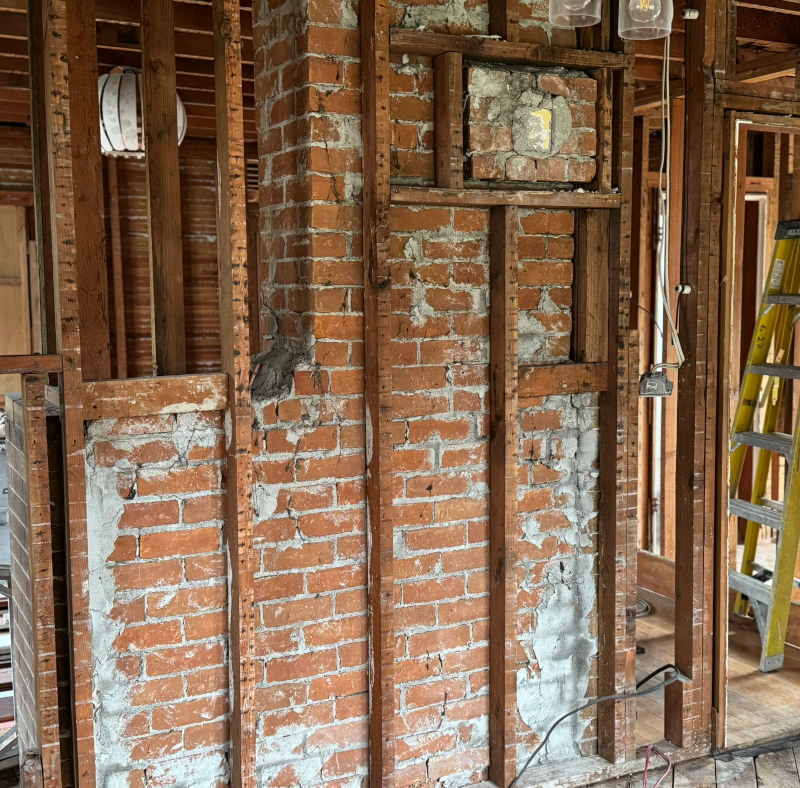
The chimney awaiting demolition
Co-Creation is the Only Viable Path
In this conversation I am going to use two flawed analogies—my 100 year-old house renovation and Google Maps. My house helps us see alternatives and trade-offs, but is not very dynamic. Google Maps is limited by a simplistic view of criteria, but nails dynamic and updated choice.
Let's start with the basics of a dynamic architecture roadmap:
- current state and known deficiency
- target state that resolves the deficiency through Gap-filling Work Packages
- transition state with some Gaps filled and harvestable value
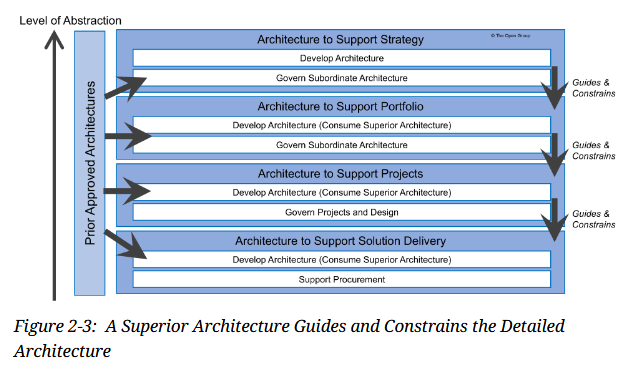
Roadmaps always start somewhere. That somewhere is the TOGAF concept of superior architecture. Most people only think about the left side of the diagram—guidance and constraints pouring down from the boss' boss and the boss' boss' boss' boss. Or from higher up.
Somewhere is not where you are going. It is where you are. Most superior architecture are prior architecture decisions. These are sneaky because they might be a detailed architecture decision, or an implementation reality.
You only find reality by actively engaging subject matter experts in your architecture analysis.
I'm not saying go out and gather everyone who might know something and bring everyone along. No. That is nonsense. It quickly becomes a long involved discussion about minutia. Irrelevant minutia.
Look at the picture above. On the right you can see where the wood burning kitchen stove was connected to the old chimney. Until I saw that brickwork the kitchen floor plan was inexplicable. Even then, I didn't need to dwell on current the pantry and oven door collisions. We were demoing the kitchen.
You are looking for inconvenient facts. I do need to know if the water supply pipe is too small to support an additional bathroom. Yeah that cost saving corner cut 25 years ago means we have to rip up the driveway to make a pipe 3mm larger. 3mm! Right there I have building code intersecting with new feature design interacting with multiple levels of existing infrastructure delivery.
Superior architecture plus in-the-ground reality crashing into a candidate architecture alternative's value calculation. Adding a sink might have meant digging up the street and driveway, turning off all water to the neighbourhood to install a new pipe. That would be an expensive sink. Not even gold taps.
We find these issues through co-creation of candidate architecture alternatives—I can't tell you how often I work with teams who skip candidate architecture alternatives. Instead obsessively drive towards a preselected target based on inferred requirements. An inferred requirement is not a requirement. It is an untested assumption. Using untested assumptions as facts is simply pretending.
You don't build stable, scalable, sustainable operations by pretending. Pretending during architecture development leads to pretending during design. Then you need to pretend during implementation.
You never get to pretend during operations. This is the “hidden human subsidy” I mentioned in our AI series. The unspoken assumption that people will work around broken processes, missing data, or flawed technology. The lies told to the sponsor and stakeholder that a project would create a sticky benefit.
Good portfolio architecture puts the facts on the table. Early, when the cost of change is cheap.
I'm not saying pretend to be omniscient and capture everything in a big giant detailed design. That is even a worse idea. That path adds pretending about omniscience to pretending about requirements.
Best practice in the Practitioner's Guide table 4 guides us—stakeholders preferences shift in response to changes in benefit, effort, and the effect of uncertainty (risk).
Just cost uncertainty in. If you have not engaged the subject matter experts with specialized knowledge—the operators, implementers, and domain specialists—you have unacknowledged uncertainty. A lot of uncertainty. Probably more uncertainty than certainty.
With unacknowledged uncertainty your stakeholders are evaluating a fantasy. Maserati's are not free, because you didn't ask the price. Data doesn't cleanse itself. Efficiency benefits are not provided by silently dropping additional work arounds into the "hidden human subsidy.”
I said cost in uncertainty. I did not say eliminate uncertainty. Start with rough math. Assume lowered benefit, assume larger scope of change, assume larger estimates of change. Ask whether the candidate still looks good? If it does, great. Sloppy estimates with lots of costed uncertainty are your best candidates. They hold together for a very long time.
Then, you get to have honest conversations with your stakeholders.
Just accept that the stakeholder will often say, 'Oh. Dang. We will not pursue that option.'
When your stakeholder chooses not to pursue a doomed-to-fail or unacceptably-risky candidate reach for your balloons and streamers. Party time! Best-practice enterprise architects celebrate every 'No'. You are celebrating a massive victory. You are celebrating that your company did not initiate doomed work. Work doomed to spend scarce time, effort and resources making the world worse.
Doctors have a professional ethic, do no harm. I wish enterprise architects would join them. We'd have less technical debt. Less organizational debt. And, a better current state.
The Artifact: Not a Gantt Chart! A Navigation Canvas
The core deliverable of Phase E isn’t a timeline. Nor a project plan. It’s an Architecture Roadmap.
Architecture roadmaps are complex work products. They must provide all of the information in the renovation design process plus everything in Google Maps and everything those flawed analogies miss. In Navigate, we use multiple types of work product to provide this depth of information. The four core roadmap work products are:
- Architecture Roadmap Type 1: Heatmap
- Architecture Roadmap Type 2: Lifecycle Chart
- Architecture Roadmap Type 3: Work Package Impact and Dependency
- Architecture Roadmap Type 4: Scenario Analysis and Multiple Candidate
Each type of work product shows you different aspects of a Candidate Target and architecture alternatives. Together they enable your stakeholder's complex value assessment—where they assess potential benefits, changes and uncertainty through the lens of concerns.
Earlier I said you need to accept informed stakeholders will say no. Then I told you to celebrate.
In my work I search for no. I love to hear a strong definitive no. In fact I prefer 'NO!!!!!! Never!!!'
At never I get to abandon a line of inquiry. Until then all I have is another plausible candidate.
Remember 'yes' is just a more pleasant 'maybe'. It simply acknowledges the candidate is plausible. Especially a yes hiding behind a transition stage.
Every transition stage (value resting point) is designed to be an off-ramp. Points where your stakeholder knows they can stop, or pivot to a different next direction. They might double-down and race forward. Pragmatically, expect stop and pivot. Off-ramps are built-in enterprise agility, supporting value capture and a different priority.
At every transition you have assessment work—find whether the transition even delivered the expected value? Test whether we are still inside the risk appetite? Or, most valuably, whether a different direction is more attractive?
Enabling enterprise agility allows inevitable stakeholder priority and preference adjustments to capture harvestable value. Stakeholders are going to change direction. Tackle new, or more pressing problems. Help them avoid leaving behind a partially rebuilt kitchen, a trench in the driveway, with the water pipe still 3mm too small. Help them find a path to at least dropping the kids at the bus stop.
Dynamic architecture roadmaps are just like Google Maps, constantly updating as reality unfolds.
Concluding Co-Creating the Dynamic Roadmap
Co-creation doesn't change the hard fact that your stakeholders own the architecture. They have the only votes to approve it.
Co-creation is not a negotiation. An implementer can tell you all day they don't like the target, Don't believe in the target. They might even say it isn't feasible. They can say it all day. If you have a solid cost, effort, and risk assessment and your stakeholder says I'll pay for that, you are golden.
Co-creation is all about facts. Your operators and subject matter experts can champion different preferred options. Explaining their different, sunnier future at every meeting. If your target addresses the current state deficiency and your stakeholder says I'll pay for that, you are golden.
Nowhere in the architecture development process is organizational change management, or placating subject matter experts. The TOGAF target architecture governance checklist simply says you need to tell the stakeholder about the disagreement and assume less confidence.
Let's be blunt you will often be developing a target that the subject matter experts, operators, and implementers do not want. Your job exists to help the organization change in ways it cannot change without you and your profession.
This means serving the stakeholder with the truth.
- the true current state and true source of the deficiency
- a target state that honestly resolves the deficiency with complete Work Packages
Your value goes through the roof when you find a transition state with enough of the deficiency filled that there is meaningful harvestable value.
Stakeholders have experience. They know every conceivable problem will not be solved. They simply want a measurably better today. They know the implementation will hit snags.
They want to know where they have risk. They want to know what work delivers value. That way they can effectively direct their portfolio. They can have confidence a corner cut is not simply transferring cost to the 'hidden human subsidy'.
Again, I'm not talking about omniscience. Find your unknown and account for it. I have a 100-year-old house. Today asbestos is a hazardous material. For most of my house's existence it was a preferred construction material—testing a couple of dozen likely spots in the house found known asbestos. Removing the known contaminated kitchen wall uncovered the contaminated concrete used to plug the unknown wood-burning stove connection to the chimney.
This week, I have a very personal and difficult challenge for you. Look at a current roadmap, preferably one that is not getting traction. Ask yourself about the target and the work packages—are they delivering on inferred requirements or tested assumptions. Did anyone have the hard conversation with the stakeholder about how valuable the sink is? Did anyone ask whether sportscar meant Maserati or Miata? How confident are you there is not asbestos lurking in the wall?
Next week, we’ll look at using this honesty. Creating a fact-based architecture that drives a portfolio of effective change work packages and transition points. Defining the constraints, the architecture specifications, that drive effective change and enable your stakeholders to control their portfolio.
As always, I welcome your comments.
Have a great day,
Dave
Dave Hornford
Conexiam

Agentic AI Playbook Conversations
Agentic AI Playbook Conversations We have been been deeply immersed in the evolving landscape of AI Adoption, engaging in a journey encompassing both technical intricacies and broader digital transformation. We developed the Business Leader’s Guide […]

Download AI Adoption Critical Capability Reference Architecture
Download AI Adoption Critical Capability Reference Architecture AI Adoption requires innovation thinking. Today we do not have proven best-practices for widespread AI Adoption that consistently improve our organizations. We require the ability to re-imagine our […]
Download Business Leader’s Guide to AI
Download Business Leader’s Guide to Artificial Intelligence Organizations that successfully apply innovative technology have had a competitive advantage. Innovative technology does not come with established success patterns and best practices. Innovative technology is novel and […]

Download the Introduction to the TOGAF Standard, 10th Edition
Download Introduction to the TOGAF® Standard, 10th Edition The TOGAF Standard, 10th Edition makes adoption of enterprise architecture best practices easier. It separates the universal concepts from proven best practice. The standard underscore where to […]

Download Capability-based Planning Guide
Download Capability-based Planning Guide Always drive to realize value. Half an improvement is 100% waste! No one teaches an Eagle to crawl, walk, or run. Eagles Fly! Download Teach your Eagles to Fly: Capability-based Planning […]

Download Business Architecture Capability Assessment Guide
Download Business Architecture Capability Assessment Guide Download a Business Architecture Capability Assessment Guide. Capability-based planning is one of the most powerful business architecture improvement techniques. Best practice of capability-based planning uses capability as a management […]

Download Sample Enterprise Architecture Principles
Download Sample Architecture Principles Download a sample enterprise architecture principles. Enterprise Architecture principles identify how to approach a problem or decision. The approach always drives you towards your enduring priorities. Download Sample Enterprise Architecture Principles […]

Download Enterprise Architecture Governance Guide
Download Enterprise Architecture Governance Guide Download the Enterprise Architecture Governance Guide to understand best practice to direct and control the development of architecture, and change to obtain the expected outcomes. Download Enterprise Architecture Governance Guide […]

Download TOGAF and SABSA Integration
Download TOGAF and SABSA Integration Bring SABSA, the world’s best security architecture framework, and TOGAF, the industry standard enterprise architecture framework together. Download TOGAF and SABSA Integration TOGAF and SABSA Integration Includes SABSA uses a […]

Download Enterprise Architecture Capability Reference Architecture
Download Enterprise Architecture Capability Reference Architecture The Enterprise Architecture Capability Reference Architecture will speed up establishing and enhancing your EA Team. Design your Enterprise Architecture Team for success. Identify and enhance the your enterprise architecture […]
Enterprise Architecture Training and TOGAF Training

Custom Enterprise Architecture Training
Custom Enterprise Architecture Training Custom enterprise architecture training addresses the professional development your EA Team needs. Good enterprise architects use a broad set of skills, method, in addition to specialized domain knowledge to develop enterprise […]

TOGAF Enterprise Architecture Training Course
Do you want training for TOGAF Certification? Demonstrate your knowledge of enterprise architecture with TOGAF Certification TOGAF® Enterprise Architecture Training Course Take a major step to be a better enterprise architect with TOGAF Standard, 10th […]

Effective Online Education
Effective Online Education Effective online education works. Students to access the best available instructor. Students control the pace of their learning. Instructors can share rich supplemental material without distracting from the primary topic. Effective distance […]

Business Architecture Training Course
Business Architecture Training Effective enterprise architecture relies on business architecture. The course gives students the skills and knowledge to develop business architecture in an enterprise architecture setting. Business architecture involves describing the structure of the […]

Enterprise Architect’s Kickstart
Enterprise Architect’s Kickstart We need to keep our skills current. More now than ever. Use the Enterprise Architecture Kickstart to improve your ability to deliver transformative enterprise architecture. This 90-day kick-start is how Conexiam Consulting […]

Avolution ABACUS Training Course
Avolution ABACUS Training Effective enterprise architecture relies on formal modeling and analysis. We provide Avolution ABACUS training from hand-on enterprise architects. Students gain skills and knowledge to create integrated enterprise and domain architectures in this […]
Go Further with Best Practice Enterprise Architecture Process and Method
Best practice enterprise architecture from Conexiam Navigate

Standing-up a Modern Architecture Review Board
Standing-up a Modern Architecture Review Board Standing-up an modern architecture review board requires creating a dynamic governance process and establishing a top-level back-stop decision-making body. The objective is to establish effective architecture governance without bureaucracy. […]

Unlocking the Power of Capability-Based Planning: A Quick Guide
Unlocking the Power of Capability-Based Planning: A Quick Guide Are you looking for a more effective way to plan and execute your business strategy? Look no further than capability-based planning. Identifying and using your organization’s […]

Enterprise Architecture Roadmap as Design
Enterprise Architecture Roadmap as Design An Architecture Roadmap is a planning tool that helps an organization’s decision-makers. A dynamic Architecture Roadmap is designed to help them develop and travel the best path forward. It also […]

Developing an Architecture View
Developing an Architecture View Enterprise architecture is an essential compass. It helps organizations navigate the complexities of technology, strategy, and operations. The core of enterprise architecture is a systematic approach. The objective is to ensure […]

Unlocking Your Business Potential: How to Create an Effective Capability Map
Unlocking Your Business Potential: How to Create an Effective Capability Map Are you struggling to identify the capabilities needed to take your business to the next level? Do you find it challenging to align resources […]

Understanding Enterprise Architecture and Agile
Understanding Enterprise Architecture and Agile Both agile and enterprise architecture are designed to reduce risk. Agile software development excels at building something that we have never had before and do not know how to build. […]

Everything You Need to Know About Using Architecture Alternatives
Everything You Need to Know About Using Architecture Alternatives Architecture alternatives are required for good enterprise architecture development. When you start architecture development, your enterprise has deficiencies. There are areas for improvement. You need to […]

Making Smarter Choices: Why Your Business Needs Architectural Decisions
Making Smarter Choices: Why Your Business Needs Architectural Decisions Enterprises are constantly confronted with the challenge of making crucial decisions. Every day, decisions, including operational practices and technology selections, have a significant impact on a […]

How to Define Enterprise Architecture Principles
How to Define Enterprise Architecture Principles To Define Enterprise Architecture Principles start with understanding what a principle is and how to apply them. Then we can develop strong architecture principles that help improve our organization. […]

Ensuring Alignment and Accountability: The Crucial Role of Enterprise Architecture Governance Checklists
Ensuring Alignment and Accountability: The Crucial Role of Enterprise Architecture Governance Checklists Enterprise Architecture Governance Checklists simplify enterprise architecture governance processes. The governance process needs to approve target architecture and provide implementation governance. A robust enterprise […]

Enterprise Architecture Governance Workshop
Enterprise Architecture Governance Workshop Enterprise Architecture Governance Workshops ensure your architecture project and implementation project have the architecture governance to succeed. You do not have time time to run failed improvement efforts. Enterprise Architecture Governance […]

Data Architecture Foundation Workshop
Data Architecture Foundation Workshop Data Architecture Foundation Workshops develop string foundations for your data architecture. Used to set the state for Data Governance Initiatives and Data Initiatives. Understand your data landscape – what are the […]

Stakeholder Engagement Workshop
Stakeholder Engagement Workshop Stakeholder Engagement Workshops start your architecture development on a firm footing. Understand your key stakeholders, their concerns, how to engage, and how to communicate. Get Help to Start Today Stakeholder Engagement Workshop […]

Scenario-Based Architecture Roadmap Workshop
Scenario-Based Architecture Roadmap Workshop Scenario-Based Architecture Roadmap Workshops develop candidate architecture roadmaps using scenario analysis. Scenario analysis tied together with architecture roadmaps are powerful tools when used early in architecture development. When you need to […]
Initiative Strategy Workshop
Initiative Strategy Workshop Initiative Strategy Workshops develop a strategy for an initiative. Used for new initiatives, and initiatives that have stumbled. Understand what actions are available to reach the outcome. Be able to articulate the […]
Enterprise Architecture Capability Workshop
Enterprise Architecture Capability Workshop The Enterprise Architecture Capability Workshop starts with your enterprise architecture use case and develops an improvement roadmap for your EA Team. The Enterprise Architecture Capability Workshop results in a designed EA […]
