
While we wish for a simple delegation—crisp, clear, singular authoritative decision maker—our organizations are designed to specialize. Sales exists to engage prospects and close the deal. Manufacturing exists to make things. Product exists to own delighting the customers. Support, recovering when those customers are sad. Every one of these functions owns part of a critical question.
In our profession, enterprise architecture, to guide change we must understand the decision space. We must understand who can direct the architects. We use concepts like SABSA governance models and Carver's open decision space to narrow down decision authority. In short, learn who is the stakeholder for which architecture decision.
We use concepts like architecture views to test candidate architecture and architecture alternatives. Again, we don't test against a mythical singular decision maker. We test against the web of decision makers' objectives and directions—performance expectation, constraint, and risk appetite.
We're smart folk. We use powerful formal models. Even then we have to ruthlessly simplify the information load. Concepts like superior architecture strip away the complexity of who and why, leaving the decisions already made.
We simplify so we can focus our attention on the current question.
In the last few weeks, I have used a simple example, a CEO's directions to Product Family A, B, and C to put a real face on these terms. In the real world, every Product Family has a value proposition, target markets and a go-to-market approach. You're with me, these are decisions already taken. Superior architecture. Same story for decisions about the company supply chain, like in-house or contract manufacturing.
On and on it goes. Settled decisions and settled directions.
When the CEO looks at the head of Product Family A and says, 'I expect higher market share in existing markets' she is giving new direction—a new narrow performance expectation and constraint. The new direction sits beside all the superior architecture.
By extension she said, 'Given your Product's market position, value proposition, design, supply chain, cost model, support model, and surrounding business activities—legal, HR, facilities, etc.—I expect higher market share in existing markets'.
Look at the free decision space. It's huge. Product Family A is awash in possibility. They are free to pick any approach that grows market share—more advertising, different customer engagement, new channels, or whatever.
A question of how to grow share will engage a strong EA Team. Not to identify the options. Let's be blunt, there are specialist subject matter experts who will craft a gazillion hypotheses. We are not needed to imagine a path to higher market share.
Before the decision to act, we are in the room to help our stakeholders understand the viability of their ideas. In Using Decisions Already Made I introduced the power of and with its buddy, the reality of if.
Before decision we use the power of and to crush inertia and open up our change space. My stakeholder, or SME, has an idea, I consider it brilliant. My job is to eliminate the barriers to their having it all.
I eliminate barriers through the reality of if. Once I know the complete set of required ifs, my stakeholder can make a value decision.
Customer engagement is a capability. Better means changing that capability by creating every if. Yes, create every if. Your presence in the room is an invitation to explore an open-ended future.
Exploring a future, the sweet spot of strong enterprise architects.
Right here I want to stop and highlight a self-defeating habit. Treating the business as a constant. Yes! Right in the sweet-spot of a future exploration we start with false constants. The assumption that the existing organization design is a decided fact. Treating existing processes as if they were dictated by the board-of-directors.
Bluntly, confusing the settled decisions of superior architecture with the scope of the question at hand.
The immediate result of embracing this myth is almost all the required ifs are lost. This myth freezes value-generating change levers to the very settings our stakeholders are unhappy about.
Over the next few weeks we are going to look at how we use business architecture to unfreeze powerful change levers. We're going to see that business architecture is just another domain. It's another way to look at parts of our enterprise with deficiencies, superior architecture, and gaps to target. All to get work packages that remove the deficiency.
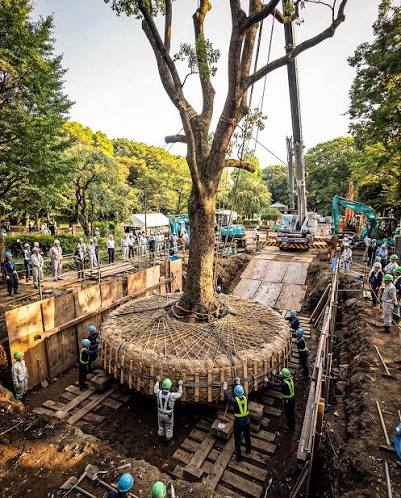
Road and tree
if
you'll move the tree
Demolishing the Myth
I know the strength of the myth. The business—yes it is always called the business in the myth—sits in some special meeting and decides exactly what they want. Then, the business rings the order bell, states demands, and impatiently awaits delivery.
The myth is laughable.
We all work in the real world, not some mythological setting. Anyone who thinks we ever had a simple order-taking process needs to think about the internet. No one in any business said, 'Hey let's do e-commerce. Step 1, invent the Internet. Step 2, invent web-servers and browsers. Step 3, convince 500 million consumers and 50 major telecom players in EU/North America to get high-speed wires moving IP packets to their homes and businesses. Step 4...'
In the real world technology and competition crash into our organizations. Modern digitally engaged organizations react to technology. They react by reorganizing, recrafting business activity, and reskilling.
They react, by changing the business.
Stop and think about it. How would we 'grow market share with our market segment' using the same organizational design, same processes, and same skills? The organization, processes, and skills that didn't do it last year. Or, the year before.
We all know the answer. We won't. Any change plan that treats the business as a constant will fail. Yes, unequivocally it will fail.
I know, there will be a distressing session of change theatre. Flashy green PowerPoints will highlight a lot of completed activity. You know what we get. A narrower, more expensive, version of exactly the same impassable canyon—that does not deliver more market share.
What is a Business Architecture?
Architecture domains give us the power to analyze and explore part of the organization. To identify the levers, accelerators, barriers, and constraints in that domain. Then link it back through the other domains.
Business architecture gives us the ability to find what needs to change, the reality ifs, and all settled decisions in superior architecture. More importantly, it gives us a language to test whether the current change idea could deliver enough value to earn permission to interfere with our successful organization.
Conceptually, business architecture is just like any other architecture domain—it explains a system. Data Architecture explains and enables the "data needs of the enterprise". Application Architecture explains "structure and interaction of the applications that support key business capabilities and manage the data assets".
Both data architecture and application architecture are impossible in the absence of a business architecture. Bluntly, where else will you find the data needs of the enterprise and what a key business capability is?
In Navigate, we break the business architecture into three parts:
First, understanding the contour of the organization. The deepest superior architecture. Explaining the business model, the ecosystem, how the company is assembled.
Second, understanding how value is measured and created. The fundamental drivers and measures. Explaining the value chain configuration, products and services, and product family specific business models.
Third, understanding the normal levers for change. Key business capabilities, activity models, and organizational design.
As we traverse from a capability model to the fundamental business model we are moving deeper into superior architecture. A change initiative can put the foundational roots of the company on the table as a required if.
However, let's be clear. Product Family A's architecture initiative to grow share is not putting the value chain, let alone the business model, into the mix. It is looking hard at the normal change levers—capabilities, activity, organizational design, and skills.
Putting the foundations on the table takes a serious transformation. Something like the NA Construction strategy case in our EA with TOGAF and Navigate course. That digital transformation was designed to change the core business model from diversified to coordinated.
Cascade and Reverb
You may have noticed whenever I talk about the business, I include technology. Whenever I talk about technology, I include business items like organization, process, skill, and knowledge.
Everything is connected. I cannot drive a change in only one domain unless I live with the myth of the constant. Pretending I can change the business without changing technology. Or, pretending I can change technology without changing the business.
Every change requires business change. Implementing assembly line robots requires organizational change. Self-driving 200-ton trucks require different skills. Simply maintaining a building full of complex integrated medical diagnostic systems requires organization, process, skill, knowledge.
That is just the first-level visible changes. Changes cascade and reverberate across the organization. The simple first-order organization and process changes can stress HR's ability to recruit and retain. Organization, process, and HR changes may drive new digital systems. The new systems can upend decades-old IT approaches. Organization, process, HR, and IT changes inevitably impact data flow and the security architecture. At every step in the cascade there are reverberations.
Those upended decades-old IT approaches mean new organization, process, and HR change. Those upended decades-old IT approaches provide a new stratum for primary business unit changes. Remember the internet? When we started using the internet—web-clients, mobile clients, SaaS—we had new possibility, opportunity, and threat. Suddenly a SME in the business could look up and say, 'Hey, we should move into e-commerce'.
Concluding Myth of the Constant
When I see the future being explored, I see a complex weave. I see the reason our organizations invest in enterprise architecture.
We provide the tools to explore a complex weave of possibilities, hopes, fears, and constraints. We facilitate an informed conversation that crosses specialist domains. A collaboration that harvests focused attention and specialized talent—across the organization and across architecture domains.
Our profession provides the rich vocabulary to discuss change. Before the decision to act we use the concept of the architecture project to tell us where we have constants, and where we have variables.
Take a minute and think about this. Depending on the architecture project and the if, a prior decision as fundamental as the enterprise's business model can be:
- a bedrock fact to work around;
- a potential variable;
- the deficiency in the current state that must change
Our NA Construction strategy case is based on a business model change. The Product Family A example I've been using, where we need to grow market share, takes the business model, the product model, the value chain, and the product value proposition as superior architecture bedrock facts.
The scope of the architecture project determines what is a constant and variable.
Here is my bald thesis—every prior architecture decision in every architecture domain is a potential variable. Whether it is a variable—whose change corrects the current deficiency—or a constant, is a function of the cost to change. Because doing the math on every potential change every day isn't worth it I use a shorthand. I seek the smoothest, smallest change across any domain.
Seriously, the smoothest, smallest set of if-based-change in any domain. I'll change anything to deliver my stakeholders' hopes and dreams. Or, squash their fears.
The business architecture domain often is filled with deep superior architecture—business model and value chain configuration. As well, our other domains exist to enable the business architecture. Despite this, the current state holds no privileged position. Other than superior architecture, everything in every domain is a variable.
In fact, most of the business architecture is easier to change than the other domains.
My challenge this week is tied to the myth of the constant. Look at your existing work. Where have you implicitly assumed a constant? Especially, where have you privileged current organization, process, and activity as a constant you must work around?
Go further, where did you think about a system change alone? Pretending that there were no required changes in organization, process, activity, and skill to implement, maintain, operate, use, and support the system?
Next week we'll continue our journey into business architecture with 'Mapping the Landscape'. Then we'll explore understanding value, before switching to driving change. As an enterprise architect, I have the most fun with business architecture. When I do my job, I'm lined-up with the organization's foundations. I can demonstrate the value. I give my stakeholders change levers that flip massive barrier boulders out of the way.
Have a great week!
As always, I welcome your feedback and questions.
Regards,
Dave
Dave Hornford
Conexiam

Agentic AI Playbook Conversations
Agentic AI Playbook Conversations We have been been deeply immersed in the evolving landscape of AI Adoption, engaging in a journey encompassing both technical intricacies and broader digital transformation. We developed the Business Leader’s Guide […]

Download AI Adoption Critical Capability Reference Architecture
Download AI Adoption Critical Capability Reference Architecture AI Adoption requires innovation thinking. Today we do not have proven best-practices for widespread AI Adoption that consistently improve our organizations. We require the ability to re-imagine our […]
Download Business Leader’s Guide to AI
Download Business Leader’s Guide to Artificial Intelligence Organizations that successfully apply innovative technology have had a competitive advantage. Innovative technology does not come with established success patterns and best practices. Innovative technology is novel and […]

Download the Introduction to the TOGAF Standard, 10th Edition
Download Introduction to the TOGAF® Standard, 10th Edition The TOGAF Standard, 10th Edition makes adoption of enterprise architecture best practices easier. It separates the universal concepts from proven best practice. The standard underscore where to […]

Download Capability-based Planning Guide
Download Capability-based Planning Guide Always drive to realize value. Half an improvement is 100% waste! No one teaches an Eagle to crawl, walk, or run. Eagles Fly! Download Teach your Eagles to Fly: Capability-based Planning […]

Download Business Architecture Capability Assessment Guide
Download Business Architecture Capability Assessment Guide Download a Business Architecture Capability Assessment Guide. Capability-based planning is one of the most powerful business architecture improvement techniques. Best practice of capability-based planning uses capability as a management […]

Download Sample Enterprise Architecture Principles
Download Sample Architecture Principles Download a sample enterprise architecture principles. Enterprise Architecture principles identify how to approach a problem or decision. The approach always drives you towards your enduring priorities. Download Sample Enterprise Architecture Principles […]

Download Enterprise Architecture Governance Guide
Download Enterprise Architecture Governance Guide Download the Enterprise Architecture Governance Guide to understand best practice to direct and control the development of architecture, and change to obtain the expected outcomes. Download Enterprise Architecture Governance Guide […]

Download TOGAF and SABSA Integration
Download TOGAF and SABSA Integration Bring SABSA, the world’s best security architecture framework, and TOGAF, the industry standard enterprise architecture framework together. Download TOGAF and SABSA Integration TOGAF and SABSA Integration Includes SABSA uses a […]

Download Enterprise Architecture Capability Reference Architecture
Download Enterprise Architecture Capability Reference Architecture The Enterprise Architecture Capability Reference Architecture will speed up establishing and enhancing your EA Team. Design your Enterprise Architecture Team for success. Identify and enhance the your enterprise architecture […]
Enterprise Architecture Training and TOGAF Training

Enterprise Architect’s Kickstart
Enterprise Architect’s Kickstart We need to keep our skills current. More now than ever. Use the Enterprise Architecture Kickstart to improve your ability to deliver transformative enterprise architecture. This 90-day kick-start is how Conexiam Consulting […]

Avolution ABACUS Training Course
Avolution ABACUS Training Effective enterprise architecture relies on formal modeling and analysis. We provide Avolution ABACUS training from hand-on enterprise architects. Students gain skills and knowledge to create integrated enterprise and domain architectures in this […]

Business Architecture Training Course
Business Architecture Training Effective enterprise architecture relies on business architecture. The course gives students the skills and knowledge to develop business architecture in an enterprise architecture setting. Business architecture involves describing the structure of the […]

Custom Enterprise Architecture Training
Custom Enterprise Architecture Training Custom enterprise architecture training addresses the professional development your EA Team needs. Good enterprise architects use a broad set of skills, method, in addition to specialized domain knowledge to develop enterprise […]

TOGAF Enterprise Architecture Training Course
Do you want training for TOGAF Certification? Demonstrate your knowledge of enterprise architecture with TOGAF Certification TOGAF® Enterprise Architecture Training Course Take a major step to be a better enterprise architect with TOGAF Standard, 10th […]

Effective Online Education
Effective Online Education Effective online education works. Students to access the best available instructor. Students control the pace of their learning. Instructors can share rich supplemental material without distracting from the primary topic. Effective distance […]
Go Further with Best Practice Enterprise Architecture Process and Method
Best practice enterprise architecture from Conexiam Navigate

Discover the Power of Enterprise Architecture Patterns
Discovering the Power of Enterprise Architecture Patterns: A Comprehensive Guide Every organization wants to improve. Streamline their operations. Enhance their enterprise agility. Align change with their strategies. Succeed at digital transformation. Enterprise Architecture, a discipline […]

How to Define Enterprise Architecture Principles
How to Define Enterprise Architecture Principles To Define Enterprise Architecture Principles start with understanding what a principle is and how to apply them. Then we can develop strong architecture principles that help improve our organization. […]

Unlocking Your Business Potential: How to Create an Effective Capability Map
Unlocking Your Business Potential: How to Create an Effective Capability Map Are you struggling to identify the capabilities needed to take your business to the next level? Do you find it challenging to align resources […]

Making Smarter Choices: Why Your Business Needs Architectural Decisions
Making Smarter Choices: Why Your Business Needs Architectural Decisions Enterprises are constantly confronted with the challenge of making crucial decisions. Every day, decisions, including operational practices and technology selections, have a significant impact on a […]

Enterprise Architecture Roadmap as Design
Enterprise Architecture Roadmap as Design An Architecture Roadmap is a planning tool that helps an organization’s decision-makers. A dynamic Architecture Roadmap is designed to help them develop and travel the best path forward. It also […]

Unlocking the Power of Capability-Based Planning: A Quick Guide
Unlocking the Power of Capability-Based Planning: A Quick Guide Are you looking for a more effective way to plan and execute your business strategy? Look no further than capability-based planning. Identifying and using your organization’s […]

Using Scenario Analysis for Enterprise Architecture
Using Scenario Analysis for Enterprise Architecture A scenario is simply a plausible future. Scenario analysis looks at how we get to a plausible future and how different scenarios impact our current choices. Scenarios help leaders […]

Standing-up a Modern Architecture Review Board
Standing-up a Modern Architecture Review Board Standing-up an modern architecture review board requires creating a dynamic governance process and establishing a top-level back-stop decision-making body. The objective is to establish effective architecture governance without bureaucracy. […]

Everything You Need to Know About Using Architecture Alternatives
Everything You Need to Know About Using Architecture Alternatives Architecture alternatives are required for good enterprise architecture development. When you start architecture development, your enterprise has deficiencies. There are areas for improvement. You need to […]

Ensuring Alignment and Accountability: The Crucial Role of Enterprise Architecture Governance Checklists
Ensuring Alignment and Accountability: The Crucial Role of Enterprise Architecture Governance Checklists Enterprise Architecture Governance Checklists simplify enterprise architecture governance processes. The governance process needs to approve target architecture and provide implementation governance. A robust enterprise […]
Enterprise Architecture Capability Workshop
Enterprise Architecture Capability Workshop The Enterprise Architecture Capability Workshop starts with your enterprise architecture use case and develops an improvement roadmap for your EA Team. The Enterprise Architecture Capability Workshop results in a designed EA […]

Enterprise Architecture Governance Workshop
Enterprise Architecture Governance Workshop Enterprise Architecture Governance Workshops ensure your architecture project and implementation project have the architecture governance to succeed. You do not have time time to run failed improvement efforts. Enterprise Architecture Governance […]
Scenario-Based Architecture Roadmap Workshop
Scenario-Based Architecture Roadmap Workshop Scenario-Based Architecture Roadmap Workshops develop candidate architecture roadmaps using scenario analysis. Scenario analysis tied together with architecture roadmaps are powerful tools when used early in architecture development. When you need to […]

Initiative Strategy Workshop
Initiative Strategy Workshop Initiative Strategy Workshops develop a strategy for an initiative. Used for new initiatives, and initiatives that have stumbled. Understand what actions are available to reach the outcome. Be able to articulate the […]
Data Architecture Foundation Workshop
Data Architecture Foundation Workshop Data Architecture Foundation Workshops develop string foundations for your data architecture. Used to set the state for Data Governance Initiatives and Data Initiatives. Understand your data landscape – what are the […]

Stakeholder Engagement Workshop
Stakeholder Engagement Workshop Stakeholder Engagement Workshops start your architecture development on a firm footing. Understand your key stakeholders, their concerns, how to engage, and how to communicate. Get Help to Start Today Stakeholder Engagement Workshop […]
