
My experience, while selective, is a loud signal of commercial demand. As are these emails, they are read and shared by tens of thousands interested in working to be better architects. Yeah, our software checks up on my readers—including you.
Collectively, there is a strong demand for the best-practice EA described in the TOGAF Practitioner's Guide. A demand to stop wasting scare resources and time. A demand to gain effective change.
Conexiam's core—we believe best practice enterprise architecture is the best way to guide effective change.
I write these emails to bring best-practice EA to life. This series focuses on what is effective change. Where a successful organization takes a calculated risk. All to get better products and services. Or, gain enterprise agility. Or, digitally transform. Or, responsibly adopt AI.
Nothing we are talking about is novel, revolutionary, or unique to Conexiam. It is all based on open methods:
The root is the TOGAF Series Practitioner's Guide
The EA use cases that sit at the center of the TOGAF Series EA Leader's Guide are expanded in our EA Capability Reference Architecture sits
The multifaceted capabilities controlling a digital transformation are the Seven Levers of Digital Transformation. A simple model adopted as a national standard
Everything comes down to the simple statement—We are not broken. But we are not happy.
Our stakeholders want confidence that willfully tinkering with a successful organization is a good idea. When they have confidence, our stakeholders go to the boss. Then the boss' boss. Even the boss' boss' boss.
With confidence, they bet their careers.
I've watched an IT Operations manager bet their career on Elastic Observability. I was there when a power generation director bet their career on old-school low-code. I watched a CFO bet their career on P5 procure-to-pay while sitting next to a division VP going all-in on S55 project controls. I bet my career on us becoming a PaaS provider.
Up and down the chain of command, change leaders put all their credibility and political capital on the line. All to gain permission to rework a successful organization. To be better.
In all my examples are simply best practice enterprise architecture. All based on what is in the TOGAF framework and the TOGAF Architecture Development Method. Reasonably simple, stable, scalable, responsive method. A method I use in every industry, in any country, at any scale of change.
With good architecture, our stakeholders are not betting. Seriously, only in the movies does someone put high-stakes outcomes on 20. In the real-world, it's boring. The TOGAF ADM was used to create knowledge.
Knowledge that starts with architecture models. Most models quickly and easily explain part of our organization—business parts, data parts, application parts, even security parts. Other models, like capability, excel at helping us direct change.
Remember, architecture models and architecture views are just consistent, rigorous analytic techniques. Navigate models are reasonably consistent and integratable. Most of my value is that they are deliberately simple. Anyone on my team or our consulting clients can create and read them. I'll take a quick, useful model over a sweet, elegant one any day. (If you want to dig deeper, the message archives have a series on building a few reference models).
I run to useful and quick because I have a foe—time. I continually battle time. Time to understanding. Time to decision. Time to completion. Time is never on my side.
Every day the outside world changes. Every day, inside our organization changes. Every single day we are further from the starting conditions. Every single day our great idea gets weaker. Eventually, the brilliant change is irrelevant. Eventually, harmful.
This is why I am fixated on enterprise agility, architecture roadmaps, and VRPs. In my battle against time, I need the freedom to stop and pivot. I demand the confidence that we will be better than at the start.
Last week, I reminded us about EA use cases—strategy, portfolio, project, and solution delivery. In every use case, our profession guides effective change. Top to bottom. Front to back. Epic to tactical. We use the same essential toolkit.
Strategy has larger, graceful changes, like sailing a freighter.
Portfolio is more nimble. But let's be honest, portfolio decisions taken today may not actually change anything until after next year's budget.
Project and Solution Delivery give us finer control and fewer choices. I always think about driving. We appear to have a lot of choices—faster, slower, turns at any intersection. We can pull off the road everywhere someone gives us a ramp and parking lot. Detailed control within narrow bounds.
This week, by addressing time, we'll dig into the hardest architecture decisions professional enterprise architects support—value realization. Product release, project, and a portfolio. Let's dig into the day-to-day.
Enough power at the right point
sets everything in motion

Working Before, During, and After
If you work with us, we'll talk about before decision and after decision. Which is simple until you realize portfolio decisions are after strategy and before project. Then it is easy to blur portfolio, project, and solution delivery conversations.
Before turns into after at the critical decision to act. Before deciding to act, everything is aimed at improving that decision. After, well, you know. You own that architecture decision. You must 'own the decision like it was your favourite idea of all time'.
Years ago I had to own a stakeholder decision minutes after the decision. I had to speak with Terry's voice, shutting down work I had passionately argued for. I had to listen to my reasons explaining why it was a mistake. I had to provide Terry’s answer and his reasons why the initiative was shut-down. I had to listen to people who believed I just didn't get it. Then monitored the change to ensure Terry’s unpopular decision was followed. I owned Terry's resolute decision not to do what I passionately believed in, like it was my favourite idea of all time.
When stakeholders follow our advice, owning the decision is easy. The professional bargain requires owning it when you disagree. Especially when you passionately disagree.
Terry had a significant digital transformation. He was betting his career. He has a beautiful portfolio architecture. It was framed as a series of separate value resting points. He had three major divisions. One was the economic center of the company. It had the farthest to go. One was his breakthrough opportunity—with the transformation and sales success, he would remake the economic center. One was his leader, furthest ahead, but with some early mistakes that would limit them.
Once we blew through VRP1, there was a clear opportunity to onboard the leader division to the transformation. They were ready to ditch their mistakes. They were ready for greatness.
It was the obvious thing to do.
So obvious that the leader organization's resources on the transformation were clamouring. So obvious these resources had privately pitched early onboarding to the division. So obvious the division had ponied up its own budget and pulled resources to join the transformation. So obvious that in the afternoon we were kicking off the onboarding.
Just before lunch, Terry said no. Keeping Terry from his lunch, I passionately re-advised. No, advised is too soft. I argued. I was emotionally invested in Terry's success, and it was obvious. Again, Terry said no and shut-down the conversation.
Terry was unwilling to take the risk that the lagging division would bank the modest transformation of VRP1 and coast to a halt. In risk terms, he would abandon the upside of a possible great-leap-forward to eliminate the downside of the laggard, structurally lagging.
I didn't eat lunch. I couldn't. After lunch, I went to the kickoff. Took my spot as transformation-visionary-in-chief, spoke with Terry's authority and told everyone there was no kick-off. There was no project. I thanked the Leading division people who had dropped everything to jump at this chance. They had to wait until VRP4 to be onboarded.
Terry refused to pivot. Terry chose the low-risk path and continued. I learned the value of stripping uncertainty and downside from my VRPs.
Concluding Stay Ahead of the Curve
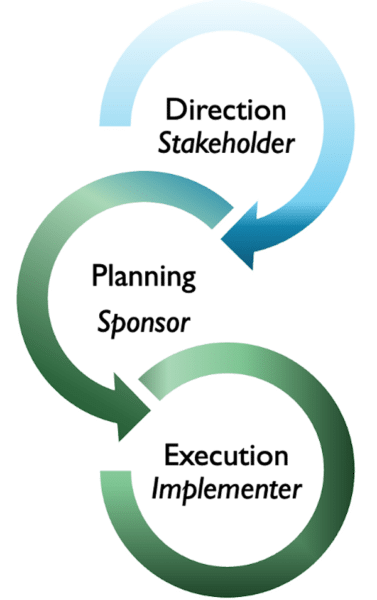 When it came time to draw a simple graphic explaining the decision cycle, thinking about Terry made us use interlocking circles. At the key junctures—direction to planning and planning to implementation—there is no guarantee the decision maker won't defer.
Defer doesn't mean wait until next quarter. Deferring can simply be a 20-minute re-evaluation of the transformation portfolio before lunch.
At those key-junctures there is no guarantee the decision maker will pivot, stop, or continue. They can easily look at the transformation portfolio in the 20-minutes before lunch and select continue.
TOGAF Phase H lives at the junctures. It is the explicit direction to the enterprise architect to pause, look backward, look forward, and look all around.
Look Backward at the completed projects. Did they deliver on the architecture contract? Did they deliver the expected value? Or more? Or less? Are there architecture non-compliant parts of the delivery that we will have to fix?
Look Forward at the potential next projects. You have the whole dynamic roadmap. The shuffling and juggling. The opportunity to switch out which organizational deficiency we'll get today. The opportunity to stomp on the gas and leap-forward!
Look all Around at the enterprise context and the state-of-the-possible. People invent new things all the time—mainframes, client-server, the internet, low-code, off-shore manufacturing, smartphones, AI, maybe even cold fusion one day. Is there anything that made your brilliant change irrelevant? How about yesterday's news? Or, is it now harmful?
This week I have the hardest challenge of all. Evaluate every one of your architecture roadmaps, VRPs, and inflight projects. If you had the freedom to re-do your brilliant advice, what would it be today? Pivot, Stop, or even Continue?
TOGAF Phase H is a concept, not an administrative activity that closes out a project. It is a living cycle where you do the work to create the information to be ready whenever your stakeholders need change advice. Sometimes they don't know they need it—I stepped into my stakeholder's office to discuss China closing Wuhan. On the last flight out, as I was getting my funky noise-cancelling headset on, Terry sat in the next seat. We had an impromptu project and solution delivery review.
By routinely looking backward, forwards, and all around, I was ready. TOGAF tells us to break our work into architecture projects because it helps us contain the possibilities. It helps us get good guidance.
When Terry sat down, he took the opportunity to think through his bets. Our conversation slid up to strategy, through portfolio, down into solutions. In EA terms, Terry was hunting expected value and uncertainty because Terry worked through others. He wanted to know what calls to make, what guideance to provide, and what questions to ask. He wanted to know what to watch for. He wanted to know his influence on value and uncertainty.
He wanted advance warning, time to think, and time to act before he had to Stop, Pivot, or Continue.
Terry, like all stakeholders, is battling time. They want every advantage in that battle. They want the best company possible. They want to crush the competition and dodge the competition's boots.
Next week we are switching gears. I've been talking about the value-producing work of enterprise architecture. How to guide that change. Over the next few months, we'll talk about the hard work we do to be prepared. The work that creates real explored options and recommendations optimized for your company. To be better than the packaged random 'standard-practices' that are not optimal for our organization, our hopes, dreams, and fears.
Have a great week!
As always, I welcome your feedback and questions.
Regards,
Dave
Dave Hornford
Conexiam
PS. Over the summer, my consulting team is having me take these messages in a different direction. We'll be diving into the developing of an enterprise architect focused on the sweet spots of supporting portfolio and supporting solution delivery. Their objective is a refresh of our practical training program EA with TOGAF and Navigate.

Agentic AI Playbook Conversations
Agentic AI Playbook Conversations We have been been deeply immersed in the evolving landscape of AI Adoption, engaging in a journey encompassing both technical intricacies and broader digital transformation. We developed the Business Leader’s Guide […]

Download AI Adoption Critical Capability Reference Architecture
Download AI Adoption Critical Capability Reference Architecture AI Adoption requires innovation thinking. Today we do not have proven best-practices for widespread AI Adoption that consistently improve our organizations. We require the ability to re-imagine our […]
Download Business Leader’s Guide to AI
Download Business Leader’s Guide to Artificial Intelligence Organizations that successfully apply innovative technology have had a competitive advantage. Innovative technology does not come with established success patterns and best practices. Innovative technology is novel and […]

Download the Introduction to the TOGAF Standard, 10th Edition
Download Introduction to the TOGAF® Standard, 10th Edition The TOGAF Standard, 10th Edition makes adoption of enterprise architecture best practices easier. It separates the universal concepts from proven best practice. The standard underscore where to […]

Download Capability-based Planning Guide
Download Capability-based Planning Guide Always drive to realize value. Half an improvement is 100% waste! No one teaches an Eagle to crawl, walk, or run. Eagles Fly! Download Teach your Eagles to Fly: Capability-based Planning […]

Download Business Architecture Capability Assessment Guide
Download Business Architecture Capability Assessment Guide Download a Business Architecture Capability Assessment Guide. Capability-based planning is one of the most powerful business architecture improvement techniques. Best practice of capability-based planning uses capability as a management […]

Download Sample Enterprise Architecture Principles
Download Sample Architecture Principles Download a sample enterprise architecture principles. Enterprise Architecture principles identify how to approach a problem or decision. The approach always drives you towards your enduring priorities. Download Sample Enterprise Architecture Principles […]

Download Enterprise Architecture Governance Guide
Download Enterprise Architecture Governance Guide Download the Enterprise Architecture Governance Guide to understand best practice to direct and control the development of architecture, and change to obtain the expected outcomes. Download Enterprise Architecture Governance Guide […]

Download TOGAF and SABSA Integration
Download TOGAF and SABSA Integration Bring SABSA, the world’s best security architecture framework, and TOGAF, the industry standard enterprise architecture framework together. Download TOGAF and SABSA Integration TOGAF and SABSA Integration Includes SABSA uses a […]

Download Enterprise Architecture Capability Reference Architecture
Download Enterprise Architecture Capability Reference Architecture The Enterprise Architecture Capability Reference Architecture will speed up establishing and enhancing your EA Team. Design your Enterprise Architecture Team for success. Identify and enhance the your enterprise architecture […]
Enterprise Architecture Training and TOGAF Training

Effective Online Education
Effective Online Education Effective online education works. Students to access the best available instructor. Students control the pace of their learning. Instructors can share rich supplemental material without distracting from the primary topic. Effective distance […]

Avolution ABACUS Training Course
Avolution ABACUS Training Effective enterprise architecture relies on formal modeling and analysis. We provide Avolution ABACUS training from hand-on enterprise architects. Students gain skills and knowledge to create integrated enterprise and domain architectures in this […]

TOGAF Enterprise Architecture Training Course
Do you want training for TOGAF Certification? Demonstrate your knowledge of enterprise architecture with TOGAF Certification TOGAF® Enterprise Architecture Training Course Take a major step to be a better enterprise architect with TOGAF Standard, 10th […]

Custom Enterprise Architecture Training
Custom Enterprise Architecture Training Custom enterprise architecture training addresses the professional development your EA Team needs. Good enterprise architects use a broad set of skills, method, in addition to specialized domain knowledge to develop enterprise […]

Enterprise Architect’s Kickstart
Enterprise Architect’s Kickstart We need to keep our skills current. More now than ever. Use the Enterprise Architecture Kickstart to improve your ability to deliver transformative enterprise architecture. This 90-day kick-start is how Conexiam Consulting […]

Business Architecture Training Course
Business Architecture Training Effective enterprise architecture relies on business architecture. The course gives students the skills and knowledge to develop business architecture in an enterprise architecture setting. Business architecture involves describing the structure of the […]
Go Further with Best Practice Enterprise Architecture Process and Method
Best practice enterprise architecture from Conexiam Navigate

Everything You Need to Know About Using Architecture Alternatives
Everything You Need to Know About Using Architecture Alternatives Architecture alternatives are required for good enterprise architecture development. When you start architecture development, your enterprise has deficiencies. There are areas for improvement. You need to […]

Understanding Enterprise Architecture and Agile
Understanding Enterprise Architecture and Agile Both agile and enterprise architecture are designed to reduce risk. Agile software development excels at building something that we have never had before and do not know how to build. […]

Using Scenario Analysis for Enterprise Architecture
Using Scenario Analysis for Enterprise Architecture A scenario is simply a plausible future. Scenario analysis looks at how we get to a plausible future and how different scenarios impact our current choices. Scenarios help leaders […]

Best Practices to Implement Enterprise Architecture Management Tools
Best Practices to Implement Enterprise Architecture Management Tools Enterprise Architecture Management Tools are designed to support the planning, design, analysis, and execution of enterprise architecture. They enable enterprise architects to examine the need for change […]

Enterprise Architecture Roadmap as Design
Enterprise Architecture Roadmap as Design An Architecture Roadmap is a planning tool that helps an organization’s decision-makers. A dynamic Architecture Roadmap is designed to help them develop and travel the best path forward. It also […]

Ensuring Alignment and Accountability: The Crucial Role of Enterprise Architecture Governance Checklists
Ensuring Alignment and Accountability: The Crucial Role of Enterprise Architecture Governance Checklists Enterprise Architecture Governance Checklists simplify enterprise architecture governance processes. The governance process needs to approve target architecture and provide implementation governance. A robust enterprise […]

Discover the Power of Enterprise Architecture Patterns
Discovering the Power of Enterprise Architecture Patterns: A Comprehensive Guide Every organization wants to improve. Streamline their operations. Enhance their enterprise agility. Align change with their strategies. Succeed at digital transformation. Enterprise Architecture, a discipline […]

Standing-up a Modern Architecture Review Board
Standing-up a Modern Architecture Review Board Standing-up an modern architecture review board requires creating a dynamic governance process and establishing a top-level back-stop decision-making body. The objective is to establish effective architecture governance without bureaucracy. […]

Making Smarter Choices: Why Your Business Needs Architectural Decisions
Making Smarter Choices: Why Your Business Needs Architectural Decisions Enterprises are constantly confronted with the challenge of making crucial decisions. Every day, decisions, including operational practices and technology selections, have a significant impact on a […]

Developing Enterprise Architecture Strategy
Developing Enterprise Architecture Strategy: Strategic Plan for Change Enterprise Architecture Strategy is action. Action your organization will take and the changes you will make to reach your strategic goals. Strategy development is all about choice. […]
Enterprise Architecture Capability Workshop
Enterprise Architecture Capability Workshop The Enterprise Architecture Capability Workshop starts with your enterprise architecture use case and develops an improvement roadmap for your EA Team. The Enterprise Architecture Capability Workshop results in a designed EA […]

Stakeholder Engagement Workshop
Stakeholder Engagement Workshop Stakeholder Engagement Workshops start your architecture development on a firm footing. Understand your key stakeholders, their concerns, how to engage, and how to communicate. Get Help to Start Today Stakeholder Engagement Workshop […]

Enterprise Architecture Governance Workshop
Enterprise Architecture Governance Workshop Enterprise Architecture Governance Workshops ensure your architecture project and implementation project have the architecture governance to succeed. You do not have time time to run failed improvement efforts. Enterprise Architecture Governance […]
Scenario-Based Architecture Roadmap Workshop
Scenario-Based Architecture Roadmap Workshop Scenario-Based Architecture Roadmap Workshops develop candidate architecture roadmaps using scenario analysis. Scenario analysis tied together with architecture roadmaps are powerful tools when used early in architecture development. When you need to […]

Initiative Strategy Workshop
Initiative Strategy Workshop Initiative Strategy Workshops develop a strategy for an initiative. Used for new initiatives, and initiatives that have stumbled. Understand what actions are available to reach the outcome. Be able to articulate the […]
Data Architecture Foundation Workshop
Data Architecture Foundation Workshop Data Architecture Foundation Workshops develop string foundations for your data architecture. Used to set the state for Data Governance Initiatives and Data Initiatives. Understand your data landscape – what are the […]
